My husband give me a treat this weekend. He took the kids and disappeared for the night!!!
Actually, he went to visit family in New Jersey, and left me all alone Saturday night into Sunday.
Of course, when he first told me he would be going away, overnight, with the kids, my first instinct was to see if any GFs were available and PARTY!!
But, the more I thought about it, the more I realized that what I really needed was to just RELAX. I'd been feeling pretty tired and run down lately, and thought it might actually be nice to just stay home, read and take a nice, long relaxing bath.
My husband left around 3 in the after noon on Saturday and the first thing I did was make myself a cup a tea and headed up to my bedroom where I through a log in the fireplace and lit it. It was probably only the third time since we've lived here that I actually had a fire in my Master-bedroom, and it was a perfect day to do so. It was pouring rain and windy outside with claps of thunder punctuating the otherwise quite house from time to time (I was really happy I had decided to just stay home).
Fire roaring, I then settled under the covers in bed and read, uninterupted for over an hour--a pretty amazing experience. Then, I took a little nap, and when I woke up, went downstairs to make myself a nice salad for dinner.
After dinner, I jumped on the treadmill for a bit while I watched a movie--uninteruppted. Then, I filled up the clawfoot tub in my master bath with nice hot water, added some Lavender scented bubble bath, and had a long, long soak.
At this point, I really wasn't missing anybody, but thought it good-form to call and feign missing them. No answer, so I left a message, got in my jammies and got to read some more.
The next morning, I got up on my own without someone telling me they were hungry and asking when I was getting up. I went to yoga, and when I got back realized that I had to return to reality. I worked in the yard some, then scrubbed down the master bath, and then the family came back home.
Monday, April 18, 2011


Friday, April 15, 2011
The Joy Of Not Cooking???


She posits that since, for many, cooking has become more of a leisure activity, we're more apt to spend more money on our kitchens and devote more square footage of them. She writes:
Perhaps we’re spending so much on our kitchens precisely because we’re using them less. When women left the kitchen, they began earning their own money—and the spending authority that comes with it. Since 1990, while the inflation-adjusted income of traditional single-earner couples has barely risen, the income of dual-earner couples has risen 16 percent. Schwefel says, “The core of my business is that 40- or 50-something woman who has more time than she did 10 years ago and is rediscovering kitchens.”She also notes that:
In other words, cooking is increasingly a leisure activity, especially at the high end of the market. My grandmother loved cooking, but it was still essentially a job: she cooked well because she wanted her family to eat well. For women today, cooking from scratch is an option—something you do when you are not hard-pressed by the demands of children and careers. Schwefel sees an increasing bifurcation between the markets for everyday equipment and for leisure cookware: the stainless-steel sauteuse for a quick weeknight stir-fry; the ebelskiver pans, and braisers, and jumbo chef’s knives for the weekends, when there’s time to use them. The split is even more striking in our recipes. The best-selling cookbooks are aspirational fare, like Julia Child’s Mastering the Art of French Cooking. Yet the No. 1 cooking magazine is Taste of Home, which relies heavily on mixes and processed foods, and offers speed and convenience rather than lifestyle fulfillment.
When we’re spending on leisure rather than drudgery, we think about our purchases very differently. Jobs are about cost-benefit analysis, which is why no one buys ultra-premium paper clips for their home office—in fact, many people who cook for a living make fun of amateurs like me, with our profusion of specialty knives and high-end pans. Leisure is as much about our pleasant fantasies as it is about what we’re actually doing. If you see cooking as an often boring part of your daily work, you’ll buy the pots you need to finish the job, and then stop. But if it’s part of a voyage of personal “rediscovery,” you’ll never stop finding new side trips to take—and everyone who’s been on a nice vacation knows the guilty pleasure of spending a little more than you should.I found this article particularly interesting because I am about to embark on my own kitchen flight-of-fantasy upscale myself.
When we bought our house 17 years ago, it came with a cute, charming kitchen that the previous owner actually built himself (he was a major do-it-yourselfer). I painted it blue (it was beige) and over the years as major appliances died, we put in a new refrigerator, stove and two dishwashers.
I posted pictures of my present kitchen above. Don't get so excited--it doesn't always look this good. Two years ago my house was on an historic house tour and this is my kitchen gussied up for the tour.
People love my kitchen, and are taken in by it's charms, but it was built by an amateur and there's all sorts of issues. For one thing, I can't open up my freezer all the way to get an ice tray out. I also have a set of drawers by the stove which I can't open unless I open the stove first. I don't have all the fancy pull out cabinets so much of my cabinet space is unreachable and so, unused. Also, some of the cabinets have started to pull from the wall and are literally being propped up by appliances like the microwave.
I also can't use the back burners on my stove for long periods of time, because you may notice from the pictures that not only do I not have an oven hood, but the cabinet is less then 12 inches above the stove top. Finally (but still not everything) the terra cotta floor is cracked all over and I have to periodically put back pieces that came up and people kicked around (it's like a giant jig saw puzzle).
So, considering its close to 30 years old, I think my kitchen's time has come. I've been meeting with the builder and architect, and hopefully we'll get going on it sometime before the end of the year.
I have to admit, the urge to not fly completely off the handle and spend a zillion dollars is tough. Kitchens are such a central part of the real estate culture these days (even though they're barely used), that its hard saying no to granite counter-tops and $10,000 Aga cookers. Fantasy does seem to want to win out over practicality.
I have to keep telling myself that I actually want to cook in this room when I'm through ripping it out and replacing it, and have to think about what will make it the most efficient and easy to clean. I also have to keep reminding myself, that, unfortunately, I don't have a zillion to spend (although the amount we will be spending is still eye-popping), and need to rein in the fantasy a bit (although granite counter-tops ARE practical when you think about it.)
Thursday, April 14, 2011
Start Small, Switch it Up and Remember to STRETCH
If any of you are not familiar with BitchCakes' blog I really encourage you to check it out here. The woman who writes this blog is truly inspirational. She completely turned her life around, and went from being, essentially, overweight and non-active to this total athletic diva--completely transforming her life and her body in the process.
Well, I was checking out her blog today and found this little video short of her interviewing fitness expert Jennifer Cohen about the Weight Watcher's Walk-It Challenge.
I thought Jennifer offered some excellent advice. First, she advised people to start slow when they begin to exercise. This is important because, as I frequently stated, the goal is to make lifetime changes. Because we're so obsessed with losing weight FAST, I think we too often dive into strenuous work-out programs which overtax us. This is plain old not fun, and what winds up happening is that exercising becomes a chore. Chores are something that we tend to want to avoid.
If you start slowly, however, and build up the intensity as we gain strength and endurance, there's a good chance that exercise will become more of a fulfilling part of our day--something we look forward to.
Jennifer's second piece of advice is also important--change up your exercise routine. If we keep doing the same thing over and over and over again, are muscles get used to the routine, you burn fewer calories, and we're likely to get bored.
Jennifer then advised that we should STRETCH!!! As a certified yoga instructor (RYT 200), I can not tell you how important it is that stretching is incorporated into your exercise regime. I'm in the process of reading Power Yoga by Beryl Bender Birch who ran the yoga program for the New York Road Runners club and she writes extensively in the book on just how various activities cause imbalances which lead to injuries and how stretching can prevent the injuries from happening (I'll try to blog more about the book when I finish).
I have a friend who is a personal fitness trainer. She injured her hip running, and I recently worked with her in a private yoga session. My friend is very fit, but once I started working with her, I immediately saw why her injury occurred. Her flexibility in the hip region was pretty limited.
I didn't charge my friend for the session, and in exchange, she gave me a personal fitness training session. Now as someone who both runs and does yoga just about everyday and hikes, skis etc., I immediately was able to grasp where my weaknesses were fitness-wise. Yoga is a fantastic stretch and toning workout, but there were obviously some areas that my yoga practice was not challenging.
Both my girlfriend and I appreciated what each of us had to offer, and we've agreed to have more fitness/yoga exchanges. I think my thighs will be very happy with the change in routine.
Wednesday, April 13, 2011
The Kitchen Diva Syndrome

Wow, I could feel myself getting so defensive over this post. Then I got to the last paragraph. Why in the world do I think "start cooking wholesome meals made from real foods" translates into I must become a kitchen diva that prepares everything from scratch. You are so right. It's simple, really. Fruit/oatmeal for breakfast; a salad or soup for lunch; etc.
No matter how much I (or any one else) works/puts time into their priorities, you are absolutely right, we can feed ourselves wholesome food that doesn't have to take hours to make.Eliza makes a great point. We all have time to make our own foods, the problem is that we've been led to believe that cooking is always complicated, time consuming and messy.
It's the Kitchen Diva Syndrome. We're so bombarded by cooking shows extolling time consuming recipes incorporating ingredients that we have to go on a scavenger hunt for, that we think that's the only way to cook.
Now, I love to cook, and really love to get in the kitchen and challenge myself culinarily by whipping up an elaborate meal.
But, let's get real here, I'm a working Mom with two kids (one who is autistic) who's also trying to fit in exercise every day. Most of my "cooking" involves whipping up a family dinner in less then 30 minutes (oftentimes less then 20), and my personal breakfast and lunches usually can't take more then five to ten minutes.
Getting dinner on the table every night, and me fed every morning and afternoon means easy, low prep, and simple ingredients (I also don't have time to run to the store every day).
Some things are just plain simple. It takes less then a minute to peel and eat a banana for breakfast. Sometimes I like to spread raw almond butter on my banana and even when I do that, it's still less then a minute. Halving and seeding a cantaloupe takes virtually no time and preparing and popping oatmeal in the microwave gets breakfast ready for me in less then 5 minutes. Probably the most elaborate stuff I make for myself for breakfast are eggs. A couple of soft boiled eggs takes about 9 minutes to make and I toast some multi-grain bread while the eggs are cooking. An egg white omelet takes about the equivalent amount of time--which is still less time then it would take to get to a fast food joint and wait for them to prepare it.
Lunch is usually a salad. I buy the pre-washed mixed greens, shredded cabbage and carrots, add some raw almonds or cashews for "crunch", and I usually chop a whole red onion at one time so that it lasts me for a week. Maybe I'll slice up some cucumber, mango, avocado or pepper, and I make my salad dressings, in bulk, about once a week. I can usually throw together a salad and get back to work on my computer in less then ten minutes.
Dinner usually takes some planning, but a light sprinkling of salt and pepper (and maybe dried parsley) on salmon or boneless chicken breast prior to slapping it on a pre-heated grill pan gets dinner ready in less then 15 minutes. While the salmon or chicken is cooking I can whip up another salad or steam broccoli or asparagus, and maybe cook some rice as well.
Cooking once and eating twice is also a staple. Some foods naturally freeze well, so if I'm making a minestrone (essentially vegetable soup) it just behooves me to make a big batch and freeze half to have when I don't have the time to prepare minestrone from scratch. Italian girl that I am, I can't fathom the concept of using jarred tomato sauce, so when I make it, I make enough for three or four meals.
I'm also a huge fan of low prep time/long baking time meals. Do you know how long it takes to prep a chicken for roasting??? Less then five minutes. It takes a while to roast (depending on the size and hour or more), but I can be working, helping the kids with homework, exercising etc., while that's happening.
So, despite what you've been led to believe by the Barefoot Contessa, Martha Stewart, Paula Deane and other Kitchen Divas, you don't have to go to elaborate lengths to prepare food for yourself. You don't even need a recipe.
Like the Nike commercial says--Just Do it. You'll be glad you did.
Tuesday, April 12, 2011
A New Way to Measure How Fat you Are

The problem with BMI, however, is that its really not all that accurate. For muscular people, such as athletes, BMI is unreliable because it only takes into account height and weight. Muscle weighs more than fat, so a muscular athlete who is the same height and weight as a fat couch potato would have the same BMI.
The new measurement, Body Adiposity Index (BAI) takes into account hip measurement in addition to height and weight. This additional measurement makes the BAI slightly more accurate in deteriming body fat on a person then BMI. It helps to differentiate between excess flab and muscular abs.
You can calculate both your BMI and BAI here. I did the calculations, and my BMI is 24.1 which is on the high side of normal, and my BAI is 29.6 which is smack dab in the middle of the healthy range.
Monday, April 11, 2011
Quote for The Day
The Dalai Lama, when asked what surprised him most about humanity, answered:
"Man. Because he sacrifices his health in order to make money. Then he sacrifices money to recuperate his health. And then he is so anxious about the future that he does not enjoy the present; the result being that he does not live in the the present or the future; he lives as if he is never going to die, and then dies having never really lived."Sometimes you just can't add to the wisdom of the Dalai Lama.
Friday, April 8, 2011
Getting Back into the Groovy 70's, Calorie Wise
Why have obesity rates risen so dramatically? Because the number of calories we eat has gone up. You have to check out the chart I've pasted above at the link--it's interactive and as you slide from left to right, it shows how calories we ingest have increased from the 1970 and what kind of calories we're consuming.
The bottom line is that, on average people now consume 23.3% more calories in a day then they did in 1970. That is a huge increase in calories. What's more, the biggest jump in calories consumed occurred between 1990 and 2008.
And, it's not just the amount of calories we consume, but how we consume them. Most of the additional calories we now consume are added fat and sugar (although we seem to be eating a hell of a lot more of everything).
I know that when I started to try to lose weight, the hardest thing was readjusting my portion sizes. We've gotten so used to super-sized portions, that when we're confronted with right-sized portions, it looks inadequate. The portions also initially seemed to leave me hungry. We're so used to overfilling our bellies, that when you get a correct sized portion, we don't feel "full."
Rather than going "cold turkey" I reduced my portions gradually. As I got used to less food, the smaller portions became more satisfying and more "filling."
I also overhauled where I got my calories from. By focusing on eating a mostly raw/vegan diet, I was able to eat more and feel satisfied while reducing my overall caloric intake substantially. Again, I did this gradually, over time, so as to not "shock" my system. Now, I'm used to eating this way, and, when I do have a "heavy" meal, I actually feel kind of hung over and sluggish the next day.
I still eat meat, dairy, fish, eggs and desserts, I just focus on eating "mostly" raw/vegan. That means that instead of a processed snack when I need a mid-morning pick-up, I eat an orange or some grapes. I eat lots of salads, and try to have a salad every night with dinner.
And, when I do eat meat, I eat less of it and more veggies. In fact, veggies and fruit, raw and cooked, make up the bulk of what I eat these days.
Thursday, April 7, 2011
Our Big Pig Problem
Scientific American has a fantastic article on our reliance on feeding antibiotics to our food animals, and the Dane's experience in stopping the practice.
The Danes, who are the world's largest exporter of pork, managed to eliminate antibiotics from their farm animals with no ill effects to the industry.
So why can't we?
The Danes, who are the world's largest exporter of pork, managed to eliminate antibiotics from their farm animals with no ill effects to the industry.
So why can't we?
Wednesday, April 6, 2011
Losing Weight Starts in the Kitchen
I saw this over at HuffPo and had to post it here. The author, has come to the same conclusion I have--you can never be thin or healthy if you let the food industry prepare your food for you.
He makes a lot of good comments including this:
Preparing your own food can be as simple as peeling and eating a banana for breakfast instead of pouring it out of a box or heading out to McDonald's for an Egg McMuffin. Throwing some lettuce in a container and adding some chopped cucumbers, onions, etc for lunch takes hardly any effort and probably takes less time to heading to Au Bon Pain to pick up a sandwich to bring back to the office.
He makes a lot of good comments including this:
What didn't make sense to me was her willingness to blame the food industry and restaurants for limiting her healthy food options, yet she was unwilling to take her health into her own hands. The fact is, our quick and easy, rapid-pace lifestyle has gotten us to where we are in the first place, and it is really going to take some effort on our parts to tip the scales in the other direction.And this:
I often hear my clients complain that they need a fast solution. They say they need to eat on the go, that they don't have time to think about eating, and that they can't even begin to think about making healthy food choices, let alone learn how to cook! We have made eating a chore, kicked it to the lowest priority on the list, and even treat it as though it were a hassle. With so many fast and cheap alternatives, why bother putting much thought into meal planning?And this:
It's so easy to blame the food industry for our current obesity epidemic, but in reality, we must all take responsibility for our own actions. We've forgotten that we are the ones who asked the industry for quicker and faster meals over the years. We sure did get what we wanted, but at what cost?
So where do we begin? Well, stop demanding quick, easy, and processed foods and start cooking wholesome meals made from real foods. This will increase the demand for nutritious foods, putting pressure on the manufacturers to increase supply and forcing them to boost their selection of real foods because now this is what their customers are asking for.Losing Weight starts in the kitchen. Pure and simple. If you take control of your food, you take control of your weight and your health. If you cede control of your food to the food industry you cede control over your own weight and health. You'll never be thin nor healthy if you insist that you can not prepare your own food. Also, the time argument is just pure BS. If you have time to run to a take out joint, you have time to make your own food.
You don't have to be Julia Childs everyday! Just pack your lunch, bring food to work, snack sensibly, and stop depending on the food industry and restaurants to fuel your life. You don't have to cut eating out completely, and believe me, I really enjoy a great meal out on the town, but I see it as a special occasion, not an everyday event.
Preparing your own food can be as simple as peeling and eating a banana for breakfast instead of pouring it out of a box or heading out to McDonald's for an Egg McMuffin. Throwing some lettuce in a container and adding some chopped cucumbers, onions, etc for lunch takes hardly any effort and probably takes less time to heading to Au Bon Pain to pick up a sandwich to bring back to the office.
Addictions
A new study shows how food is just as addicting as drugs.
I fully believe this. I know from my own experience that I just can't have certain foods around me because if I see them, I eat them.
I fully believe this. I know from my own experience that I just can't have certain foods around me because if I see them, I eat them.
Monday, April 4, 2011
First Hike of the Year
Yesterday the weather managed to not be frigid, there was some sun, and we hadn't had a really heavy rain all week. Since the likelihood of getting mired knee-deep in mud was slim, I decided to take my 16 year old son, who is on the autistic spectrum, for our first hike of the new year.
We happen to be fortunate to live literally around the corner from a 1,700 acre nature preserve called Devil's Den. Devil's Den spans several towns here in Connecticut and there are hiking trails throughout the preserve. I've been taking advantage of a fortunate proximity to hike with both my family and friends ever since I've lived in Weston.
With all the snow this Winter, I did manage to get into the Den a few times to snow shoe. But with all the snow and rain, and the tendency of Devil's Den to get really muddy, I've been avoiding going in for the last 6 weeks.
But yesterday seemed to be a good day to finally head back in, so I got my hiking boots on and told my son he was coming with me for a short hike (you have to delineate these things for him, we have some set hikes he knows by heart which takes the anxiety out of the equation for him).
I wasn't the only person who thought that way. When I got to the Den entrance, the parking lot was completely filled and cars were parked all the way down the road leading to the entrance. But that's a good thing--more hiking.
My son and I climbed out of the car, covered ourselves in repellent in case the Lyme ticks were out (it was probably too cold, but after having Lyme 3 times I don't take risks), and off we headed into the woods.
I was chilly when we first started, but after 15 minutes of hiking up hill, I warmed up, and by the time we ended our hike 45 minutes later, I had a good sweat worked up.
And, according to my calorie estimator, I burned 263 calories.
Now that the weather is finally warming up (we hope but its been a wild and crazy year), I'll be doing a lot more hiking again.
We happen to be fortunate to live literally around the corner from a 1,700 acre nature preserve called Devil's Den. Devil's Den spans several towns here in Connecticut and there are hiking trails throughout the preserve. I've been taking advantage of a fortunate proximity to hike with both my family and friends ever since I've lived in Weston.
With all the snow this Winter, I did manage to get into the Den a few times to snow shoe. But with all the snow and rain, and the tendency of Devil's Den to get really muddy, I've been avoiding going in for the last 6 weeks.
But yesterday seemed to be a good day to finally head back in, so I got my hiking boots on and told my son he was coming with me for a short hike (you have to delineate these things for him, we have some set hikes he knows by heart which takes the anxiety out of the equation for him).
I wasn't the only person who thought that way. When I got to the Den entrance, the parking lot was completely filled and cars were parked all the way down the road leading to the entrance. But that's a good thing--more hiking.
My son and I climbed out of the car, covered ourselves in repellent in case the Lyme ticks were out (it was probably too cold, but after having Lyme 3 times I don't take risks), and off we headed into the woods.
I was chilly when we first started, but after 15 minutes of hiking up hill, I warmed up, and by the time we ended our hike 45 minutes later, I had a good sweat worked up.
And, according to my calorie estimator, I burned 263 calories.
Now that the weather is finally warming up (we hope but its been a wild and crazy year), I'll be doing a lot more hiking again.
Friday, April 1, 2011
Fasting to Get Closer to God
I've covered modern attitudes about fasting before, but after I saw this article in the New York Times regarding fasting and religion, thought it was time to bring it up again.
You can tell the extent of the food industry's brainwashing of the American public by the appalled reactions you get when you bring up fasting.
Tell someone that you're going to fast for a day or two, and you're viewed as crazy, out of the ordinary, and jeopardizing your health. People shake their heads and will actually ask you why you would even do such a thing as go 1 day without eating.
But, when you look back on history, fasting was part of the regular cycle of human existence, and often tied to religious observance. Fasting during Lent, Ramadan or Yom Kipper were part of the natural cycle of the religious year and preparing yourself to be closer to God.
If you go back even further, fasting was often just a part of human existence. Our ancient ancestors fasted because, sadly, they often didn't have access to food.
So, although the modern food industry has convinced us that we need to be constantly stuffing our pie-holes day in and day out, in actuality our bodies are designed to go days without food from time to time.
In our modern world, food is so readily available, that the problem is that we spend billions trying to negate the effects of eating that bounty, i.e, lose the fat.
The reality is that fasting for one day a month, is probably healthier then sticking to the 3 meals a day, every day, dogma that we've espoused. But we are now so surrounded by food and food advertising that consciencely not eating is unthinkable.
Now, of course, there is a difference between healthy fasting, and eating disorders. Short term fasting for health or religious reasons is, well, healthy. Short or long term fasting for no other reason then to try to loose weight is unhealthy.
You can tell the extent of the food industry's brainwashing of the American public by the appalled reactions you get when you bring up fasting.
Tell someone that you're going to fast for a day or two, and you're viewed as crazy, out of the ordinary, and jeopardizing your health. People shake their heads and will actually ask you why you would even do such a thing as go 1 day without eating.
But, when you look back on history, fasting was part of the regular cycle of human existence, and often tied to religious observance. Fasting during Lent, Ramadan or Yom Kipper were part of the natural cycle of the religious year and preparing yourself to be closer to God.
If you go back even further, fasting was often just a part of human existence. Our ancient ancestors fasted because, sadly, they often didn't have access to food.
So, although the modern food industry has convinced us that we need to be constantly stuffing our pie-holes day in and day out, in actuality our bodies are designed to go days without food from time to time.
In our modern world, food is so readily available, that the problem is that we spend billions trying to negate the effects of eating that bounty, i.e, lose the fat.
The reality is that fasting for one day a month, is probably healthier then sticking to the 3 meals a day, every day, dogma that we've espoused. But we are now so surrounded by food and food advertising that consciencely not eating is unthinkable.
Now, of course, there is a difference between healthy fasting, and eating disorders. Short term fasting for health or religious reasons is, well, healthy. Short or long term fasting for no other reason then to try to loose weight is unhealthy.
Thursday, March 31, 2011
If You Can't Beat them, just Market the product Differently

I'm guessing that the message about drinking high-sugar beverages must be seeking into the general populace because Coke is now essentially telling people that it's OK to drink a nutritionally devoid, sugar laden, chemical-filled beverage so long as you do it in moderation, and, oh yeah, exercise.
I tried to find the actual full-page Coke ad somewhere on line and couldn't but, according to Nestle, this is what it says:
Our nation is facing an obesity problem and we plan on being part of the solution. By promoting balanced diets and active lifestyles, we can make a positive difference.
For some people, a 12-fl.-oz. beverage may be too much. Everyone’s needs are different. So we’ve created a variety of package sizes….
While keeping track of calories is important, so is burning them off. In our partnership with the Boys & Girls Clubs of America, we’ve helped more than one million kids learn the importance of physical activity and proper nutrition….
Hm-m-m-m. Methinks the corporation protests too much. I love that they are using marketing to reposition themselves as being--well--not as crappy as they really are, and, by the way, you could just exercise to work off those extra nutritionally-useless calories you just consumed.
OK, there are 155 calories in a can of Coke classic. That means that if you are a 135 pound, 5'5", 50 year old woman you would have to either walk for more than an hour, jog for approximately 1/2 an hour, or work out at the gym for about 45 minutes.
I don't know what your day is like, but for me, trying to find an the extra exercise time to work off that Coke just isn't there.
As a former diet soda addict (clean over 20 years now), I can attest that there is absolutely no reason to drink any kind of soda at any time. I not only don't ever drink soda ever, I never have it in my house anymore, even for guests, and have never provided soda to my children. Both my son and daughter have tried soda (offered to them by others when I wasn't around), and both will now turn it down when offered to them.
Getting off of soda helped get rid of a lot of the "bloat" (water retention) that I used to have, and I found I wasn't as fatigued as before. Furthermore, I stopped being plagued by constant head-aches.
By not serving (or offering) my children soda, they actually PREFER drinking water. I kid you not. Offer my kids a soda, and they'll ask for a bottle of water. Both also love real fruit juices (100% juice or nothing).
I wish my parents had been as strict with me.
Wednesday, March 30, 2011
Is Exercising in our Genes?

Turns out there may be a genetic reason why some of us love to exercise while others loathe it.
I'm in the love it catagory. I always loved a good strenous work-out-whether it was skiing, hiking, running--you name it. That's why I love Ashtanga yoga. I've taken plenty of friends with me to an Ashtanga class and their reaction was "too hard, I never want to do this again."
Tuesday, March 29, 2011
Nutritional Propaganda--Eating Breakfast
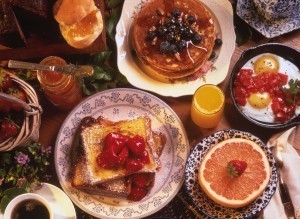
I've always been leery of "nutritional propaganda." You know, campaigns trying to convince you that you should be eating (or not eating) this or that.
One bit of traditional advice that I've always held suspect was the idea that too lose weight, you had to eat a humongous breakfast.
Now, I'm one of those people who has to eat breakfast. Don't ask me why, but I can't get through my morning without having something, even if it's a little fruit to get me going.
But, if I've had a lot to eat the day before, I always thought it insane that you're supposed to then eat some huge breakfast the next day. Let's face it, if I went out for a special meal with my husband the night before, I'm just not all that hungry.
It always seemed strange to me that we were somehow biologically programmed to eat breakfast every morning when our ancient ancestors basically ate when they got food, and that often meant days with no food much less three distinct meals.
And, if you're the type that just isn't all that hungry in the morning, then why should you stuff your face when you're not in the mood?
So, I've always held the "eat breakfast" and "breakfast is the most important meal of the day" mantras with some speculation, generally attributing them to propaganda promulgated by all those food manufacturers selling breakfast cereal.
It just didn't make sense. If you eat when you're not hungry, how on earth does that induce you to eat less throughout the day?
Well, as it turns out, my skepticism was justified. New research shows that eating breakfast does not lead to a cut in the overall intake of daily calories. The study showed that people ate the same at lunch and dinner irregardless of what they ate for breakfast. If someone ate 400 calories for breakfast, then they generally ate 400 calories more then the person who didn't eat breakfast.
I think that to control weight, it's more important to listen to your body then watch the clock. If you're hungry, eat, if not, don't even if the clock says its time for breakfast, lunch or dinner.
Cleansing Is Hell-But worth it.
Last week, I posted that I was starting a spring cleanse using the Nature's Secret product The Ultimate Cleanse. It's a product I've used before with some success. Yesterday, however, one of my commentators wrote to me:
My curiosity was peeked, so I went to Amazon to read the reviews. I have to admit that some of them were pretty negative, but since I've cleansed before, not unexpected. Most of the "bad" side effects they detailed, were pretty typical of what happens during a cleanse.
The problem, I guess, was that people bought into the idea of "cleansing" without fully understanding what it means to cleanse. I started using the Ultimate Cleanse on the advice of my knowledgeable, local health food store dude. You know the type, an older, former hippy-type, with long, flowing gray hair.
The first time that I did the Ultimate Cleanse cleanse, I had already done several hard-core cleanses, including a couple of juice fasts and a raw food vegan fast. So, I was already pretty "clean," and didn't really have any extreme reactions.
I'm going to be honest here--cleansing when you start doing it can be pretty uncomfortable. It's no walk in the park. It's not uncommon to feel like absolute shit the first couple of times you cleanse during the actual cleansing period. Afterwards you feel great, but the first few times I did cleanses, I had serious head-aches, ran fevers and my skin broke out--all pretty typical experiences.
You feel awful, because as you "cleanse" toxins stored in your fat are re-released into your system. The cleanse helps you to rid your body of these toxins, but before they clear out you full just awful. We all react to cleanses in our own ways. My sister when she cleanses has to set days aside to do nothing but sleep.
I'm at a point now that when I cleanse, most of the worst stuff is behind me. I feel a little sluggish, get a couple of minor break-outs, and maybe want to take a nap now and again, but it's basically all stuff I can deal with.
I know many plenty who are willing to "suffer to be beautiful." As someone who's gone through her own share of bikini waxes, I can attest to suffering for beauty myself. So, it always mystifies me why these same people find it intolerable to do a little "suffering" to be clean of toxins? In the end, it makes you beautiful as well.
I got the Detox package you posted a few days ago, and since Tuesday night I have been taking it. After I got the package I started reading the Amazon review and was not very comfortable to take it, but since I had opened the package I did. On Amazon some people had posted about side effects, but I have to say, I am not experiencing any side bad effects. I am experiencing side effects as explained there, but nothing uncomfortable.
My curiosity was peeked, so I went to Amazon to read the reviews. I have to admit that some of them were pretty negative, but since I've cleansed before, not unexpected. Most of the "bad" side effects they detailed, were pretty typical of what happens during a cleanse.
The problem, I guess, was that people bought into the idea of "cleansing" without fully understanding what it means to cleanse. I started using the Ultimate Cleanse on the advice of my knowledgeable, local health food store dude. You know the type, an older, former hippy-type, with long, flowing gray hair.
The first time that I did the Ultimate Cleanse cleanse, I had already done several hard-core cleanses, including a couple of juice fasts and a raw food vegan fast. So, I was already pretty "clean," and didn't really have any extreme reactions.
I'm going to be honest here--cleansing when you start doing it can be pretty uncomfortable. It's no walk in the park. It's not uncommon to feel like absolute shit the first couple of times you cleanse during the actual cleansing period. Afterwards you feel great, but the first few times I did cleanses, I had serious head-aches, ran fevers and my skin broke out--all pretty typical experiences.
You feel awful, because as you "cleanse" toxins stored in your fat are re-released into your system. The cleanse helps you to rid your body of these toxins, but before they clear out you full just awful. We all react to cleanses in our own ways. My sister when she cleanses has to set days aside to do nothing but sleep.
I'm at a point now that when I cleanse, most of the worst stuff is behind me. I feel a little sluggish, get a couple of minor break-outs, and maybe want to take a nap now and again, but it's basically all stuff I can deal with.
I know many plenty who are willing to "suffer to be beautiful." As someone who's gone through her own share of bikini waxes, I can attest to suffering for beauty myself. So, it always mystifies me why these same people find it intolerable to do a little "suffering" to be clean of toxins? In the end, it makes you beautiful as well.
Monday, March 28, 2011
We've Got More Junk in Our Collective Trunk
According to the Federal Transportation Administration we need bigger seats on buses because we've got too much junk in our trunks. We've gotten so much fatter that the FTA is recommending that seats be designed to accommodate an average passenger weight 175 pounds versus the previous 150 pounds. I guess the good news is that bigger seats on buses will mean fewer seats on buses, forcing more people to stand (and thus burn more calories). God knows we can use it.
All Natural? Really?
 You know that the words "all Natural" on a package has reached a new low of meaningless when Frito-lay starts putting them on a package of Barbeque-flavored potato chips. I thought that this WSJ piece on how Frito-Lay and Kraft are reformulating their junk food to make them less junky and slap the label "all Natural" on them was quite illuminating. But while removing some of the junkier ingredients in junk food is, of course, a positive step, in the end you have to remember that these "all Natural" products are just a better class of crap. The article writer seems have agreed with me:
 I think Marion Nestle said it well here:
Making snacks with natural ingredients doesn't necessarily make them healthy, nutritionists and industry critics caution, even if they are potentially less bad. That includes potato chips, which contain a lot of fat and salt. The revamped Frito-Lay's chips' fat and sugar content hasn't changed much.
"Foods that are less loaded with sugar, fat and salt, that's what's important. Everything else is marketing," says David Kessler a former Food and Drug Administration commissioner and snack-industry critic.
But isn’t a “healthy” processed snack food an oxymoron? They can tweak and tweak the contents, but these products will still be heavily processed. Too much evidence now concludes that marketing a product as “healthy” or “natural” makes people think it has no calories. And as I keep saying, just because a processed food is a little bit less bad than it used to be, doesn’t necessarily make it a good choice.
Stay Away from those Non-Stick Pans
I've written before about the dangers of those chemical laden "miracle" non-stick pans, but now there's even more evidence that Teflon plans should be avoided.
Turns out that the main ingredient used in these pans, PFC's, can bring on early menopause.
But then, if a pan has to come with a warning not to have a bird in the room when you heat it up, shouldn't that tell you something?
Me, I'll continue to stick with my seasoned cast iron pans.
Turns out that the main ingredient used in these pans, PFC's, can bring on early menopause.
But then, if a pan has to come with a warning not to have a bird in the room when you heat it up, shouldn't that tell you something?
Me, I'll continue to stick with my seasoned cast iron pans.
Friday, March 25, 2011
Response to a Reader
I had a response to this post that I thought I should respond to. The commenter wrote:
This isn't an unusual response. I've gotten this "the government shouldn't get involved" mantra before. What I found curious about it was that while the commentator first says "government stay out, let parents be in charge," she then ADVOCATES GOVERNMENT INVOLVEMENT in the form of removing soda machines, etc. from schools.
It always mystifies me when people are completely unaware of what government involvement means. I'm always baffled by the people who scream whenever there's a pot-hole in the road, but then go to rallies saying they've against taxes.
EARTH TO PEOPLE OF THE UNITED STATES IF YOU WANT SMOOTH ROADS, BRIDGES THAT DON'T FALL DOWN, SCHOOLS THAT CAN EDUCATE KIDS TO COMPETE WITH OTHER COUNTRIES, PUBLIC BEACHES AND PARKS, ETC. THEN YOU HAVE TO PAY TAXES.
This is reality, our current rates of low taxation are COMPLETELY UNSUSTAINABLE. There is absolutely NO WAY to continue them without dramatic cuts to just about every single public service we hold dear.
The point of yesterday's post advocating that Congress do something about child-hood obesity, was that the majority of people now want government action. Government would not be "controlling" our lives, but controlling the manufacturers making profits off of making our kids fat. And, that's the rub, by "controlling" these manufacturers, it's likely that they'll make less money.
That did not use to be a problem when it came to our government protecting us. Now it is. Now, when corporations stand to make less profits, we the public lose.
But still, I get this "we don't want the government controlling us" argument.
Ok, here's reality--Government taking intervention has saved countless lives in this country.
Do you think the government shouldn't have gotten involved after the Triangle Shirtwaist factory fire? Wasn't government intervention there, in the form of work-place safety regulations better? Or do you really believe that government shouldn't have stepped in and regulated manufacturers and let people continue to die?
I mean, if you read about Triangle you hear echos of today. Here's what one writer had to say about it:
How about food safety rules? Do you have any idea how many Americans died from unsanitary food prior to those rules being put in place?
Huge corporations and billionaires have spent billions of dollars to convince the public that any kind government regulation of business is "bad." If government was really so "bad" then, why would these people have to spend so much to buy our thoughts and politicians? Wouldn't we just all gravitate to that view?
The truth is, that governments have always existed for one reason--to protect their citizens. If the king didn't effectively do it he eventually got thrown out, and as events in the Middle East show, even violent dictators have to eventually pay the price for not safeguarding their citizenship.
Right now our government isn't doing a very good job of protecting us because the people its supposed to have protected us against, bought it and managed to buy enough of the media to convince the very people who are getting screwed by the lack of government control, that lack of government control is what they want.
At the risk of drawing a lot of ire - why does it need to be the government that does something? We don't need government control in every aspect of our lives - and once we invite it in, it's too hard to get rid of if it doesn't work. Parents need to take back control of teaching their children how to make good choices - and they need to band together on a local level to have their schools remove or limit the soda machines, etc. Start forcing the local school boards to take action by being a vocal parent.
This isn't an unusual response. I've gotten this "the government shouldn't get involved" mantra before. What I found curious about it was that while the commentator first says "government stay out, let parents be in charge," she then ADVOCATES GOVERNMENT INVOLVEMENT in the form of removing soda machines, etc. from schools.
It always mystifies me when people are completely unaware of what government involvement means. I'm always baffled by the people who scream whenever there's a pot-hole in the road, but then go to rallies saying they've against taxes.
EARTH TO PEOPLE OF THE UNITED STATES IF YOU WANT SMOOTH ROADS, BRIDGES THAT DON'T FALL DOWN, SCHOOLS THAT CAN EDUCATE KIDS TO COMPETE WITH OTHER COUNTRIES, PUBLIC BEACHES AND PARKS, ETC. THEN YOU HAVE TO PAY TAXES.
This is reality, our current rates of low taxation are COMPLETELY UNSUSTAINABLE. There is absolutely NO WAY to continue them without dramatic cuts to just about every single public service we hold dear.
The point of yesterday's post advocating that Congress do something about child-hood obesity, was that the majority of people now want government action. Government would not be "controlling" our lives, but controlling the manufacturers making profits off of making our kids fat. And, that's the rub, by "controlling" these manufacturers, it's likely that they'll make less money.
That did not use to be a problem when it came to our government protecting us. Now it is. Now, when corporations stand to make less profits, we the public lose.
But still, I get this "we don't want the government controlling us" argument.
Ok, here's reality--Government taking intervention has saved countless lives in this country.
Do you think the government shouldn't have gotten involved after the Triangle Shirtwaist factory fire? Wasn't government intervention there, in the form of work-place safety regulations better? Or do you really believe that government shouldn't have stepped in and regulated manufacturers and let people continue to die?
I mean, if you read about Triangle you hear echos of today. Here's what one writer had to say about it:
Aided by Frances Perkins, a young social worker who was in Washington Square looking on in horror as the seamstresses jumped to their deaths, Smith and Wagner visited hundreds of factories and sweatshops. Over time, they authored and enacted legislation that required certain workplaces to have sprinklers, open doors, fireproof stairwells and functioning fire escapes; limited women’s workweeks to 54 hours and banned children under 18 from certain hazardous jobs. (Years later, Wagner, by then a U.S. senator, authored — with help from Perkins, who had become labor secretary — the legislation establishing Social Security; he also wrote the bill legalizing collective bargaining.)
Businesses reacted as if the revolution had arrived. The changes to the fire code, said a spokesman for the Associated Industries of New York, would lead to “the wiping out of industry in this state.” The regulations, wrote George Olvany, special counsel to the Real Estate Board of New York City, would force expenditures on precautions that were “absolutely needless and useless.”
“The best government is the least possible government,” said Laurence McGuire, president of the Real Estate Board. “To my mind, this [the post-Triangle regulations] is all wrong.”
Such complaints, of course, are with us still. We hear them from mine operators after fatal explosions, from bankers after they’ve crashed the economy, from energy moguls after their rig explodes or their plant starts leaking radiation. We hear them from politicians who take their money. We hear them from Republican members of Congress and from some Democrats, too. A century after Triangle, greed encased in libertarianism remains a fixture of — and danger to — American life.
How about food safety rules? Do you have any idea how many Americans died from unsanitary food prior to those rules being put in place?
Huge corporations and billionaires have spent billions of dollars to convince the public that any kind government regulation of business is "bad." If government was really so "bad" then, why would these people have to spend so much to buy our thoughts and politicians? Wouldn't we just all gravitate to that view?
The truth is, that governments have always existed for one reason--to protect their citizens. If the king didn't effectively do it he eventually got thrown out, and as events in the Middle East show, even violent dictators have to eventually pay the price for not safeguarding their citizenship.
Right now our government isn't doing a very good job of protecting us because the people its supposed to have protected us against, bought it and managed to buy enough of the media to convince the very people who are getting screwed by the lack of government control, that lack of government control is what they want.
Thursday, March 24, 2011
OK Congress--Do Something
According to a recent poll, the majority of Americans think that the government should do something about child-hood obesity.
Of course, although significant majorities see the need for government intervention, and the number will likely rise, the likelihood of the government actually doing something is slim.
That's because food manufacturers have big bucks to put in politicians pockets, and food manufacturers want to keep kids fat and obese because that's how they make money.
If the government was going to do something, it would be measures, like taxing soda, that reduce consumption. That would hurt profits.
So, while I take heart that the "we have the right to eat desert" message of the Palin faction of this country is pretty much only resonating with a small group of ignorant idiots, the reality is nothing will change.
Rather sad.
Of course, although significant majorities see the need for government intervention, and the number will likely rise, the likelihood of the government actually doing something is slim.
That's because food manufacturers have big bucks to put in politicians pockets, and food manufacturers want to keep kids fat and obese because that's how they make money.
If the government was going to do something, it would be measures, like taxing soda, that reduce consumption. That would hurt profits.
So, while I take heart that the "we have the right to eat desert" message of the Palin faction of this country is pretty much only resonating with a small group of ignorant idiots, the reality is nothing will change.
Rather sad.
Wednesday, March 23, 2011
Diet Vieux, Nouveau Nom

There's a new fad diet on the horizon, and this one is connected to royalty. The Dukan diet has been popular in Europe for a while now, but its promoters are now bringing it to the US.
The Dukan diet sounds a lot like Atkins and South Beach, in that it involves eating copious amounts of protein but very little carbs. Just the name is new.
Something tells me in the next few months I'll be having to arrange my lunch dates with girlfriends around their "Dukaning." In other words, they'll be no sharing of Paella because someone can't eat the rice.
I've been through this before, I had countless friends on both Atkins and South Beach.
And, you know what? Those friends all regained whatever weight they lost while on those diets.
So here we go again.
Tuesday, March 22, 2011
Losing Weight Starts in the Kitchen

I was happy to see this little piece on Jezebel. I'm always thrilled to hear or read about someone taking the time and the initiative to learn to cook.
What disturbed me, however, is that quite a few of the comments to this story were from people declaring that they didn't know how to cook and never wanted to learn.
I was particularly shocked by the number of people writing that they purposedly refuse to learn to cook, because if they do, people will expect them too.
I want my family to expect me to cook for them, and eventually I want them to cook for themselves.
The only way to control what goes into your body and the bodies of your family is to prepare your own food.
Whether you get processed convenience foods, take-out, or go to restaurants, you are ceding a measure of control over your own body to someone else, and that is never a good thing.
Of course I cook for my children. Do you have any idea what goes into kid's convenience foods? Read the label, and you'll be scrambling up eggs for the kids regularly as well.
Monday, March 21, 2011
Six Rules for Weight Loss
1. Losing Weight for good is a life commitment, not a temporary change. To put it plainly, you got fat because of your current eating habits, so if you go back to them, you'll get fat again. The only way to take weight off and keep it off is to make permanent changes to your diet.
2. Losing Weight starts in the kitchen. Take control of your food and you take control of your weight. Take-out food, restaurant food and convenience foods will make you fat. That is a fact. Portions are too large, and the food contains too much fat, sodium and calories. If you want to lose weight for good, you have to learn your way around a kitchen, and you have to learn to prepare food for yourself.
3. Don't believe advertisements or health or weight control claims on packaging. The goal of advertisements and claims on product packaging is to sell stuff, not make you healthier or thinner. Chances are that if the box says it will help you get thinner, it's more likely that the product will actually make you fatter.
4. Eat better eat less. Eat higher quality foods, such as organic, and eat less of it. Scale down your portion sizes and focus on higher quality foods made from fresh fruits and vegetables. If you eat meat, fish and dairy, go organic. Yes you'll pay more, but you should be eating less anyway. If you go to a restaurant, your goal should not be to get the most food for your money, but the best food for your money.
5. You can't do it alone. If you have a family, you have to bring the whole family along to better eating. You can't sit at the dinner table for the rest of your life eating a salad while the rest of your family gorges on cheeseburgers. The whole family needs to be cutting back on junk foods, meat, dairy and overly processed foods. It's not easy, but if you take it slow and introduce healthy foods slowly while at the same time eliminating unhealthy food, it can be done. Better yet, don't introduce unhealthy foods to begin with, and make things like soda a special treat.
6. You have to move more. Getting to the gym is great, but you have to learn how to incorporate more movement into your daily life. When we were an agricultural society, it wasn't unusual for people to burn through 7,000 calories a day--so they could eat all the bacon and dairy they could get our hands on (which was still less then what we eat today). In today's world, many of us only burn through 2,000 or fewer calories a day. Learning to incorporate more movement into our everyday lives is probably one of the best things you can do for weight control. For example, take the stairs instead of the escalator or elevator, take the extra trip up the stairs instead of letting things pile up on the bottom for one big trip up, walk to your mailbox instead of waiting to drive by it, learn to walk around and pace while you're on the phone instead of sitting.
2. Losing Weight starts in the kitchen. Take control of your food and you take control of your weight. Take-out food, restaurant food and convenience foods will make you fat. That is a fact. Portions are too large, and the food contains too much fat, sodium and calories. If you want to lose weight for good, you have to learn your way around a kitchen, and you have to learn to prepare food for yourself.
3. Don't believe advertisements or health or weight control claims on packaging. The goal of advertisements and claims on product packaging is to sell stuff, not make you healthier or thinner. Chances are that if the box says it will help you get thinner, it's more likely that the product will actually make you fatter.
4. Eat better eat less. Eat higher quality foods, such as organic, and eat less of it. Scale down your portion sizes and focus on higher quality foods made from fresh fruits and vegetables. If you eat meat, fish and dairy, go organic. Yes you'll pay more, but you should be eating less anyway. If you go to a restaurant, your goal should not be to get the most food for your money, but the best food for your money.
5. You can't do it alone. If you have a family, you have to bring the whole family along to better eating. You can't sit at the dinner table for the rest of your life eating a salad while the rest of your family gorges on cheeseburgers. The whole family needs to be cutting back on junk foods, meat, dairy and overly processed foods. It's not easy, but if you take it slow and introduce healthy foods slowly while at the same time eliminating unhealthy food, it can be done. Better yet, don't introduce unhealthy foods to begin with, and make things like soda a special treat.
6. You have to move more. Getting to the gym is great, but you have to learn how to incorporate more movement into your daily life. When we were an agricultural society, it wasn't unusual for people to burn through 7,000 calories a day--so they could eat all the bacon and dairy they could get our hands on (which was still less then what we eat today). In today's world, many of us only burn through 2,000 or fewer calories a day. Learning to incorporate more movement into our everyday lives is probably one of the best things you can do for weight control. For example, take the stairs instead of the escalator or elevator, take the extra trip up the stairs instead of letting things pile up on the bottom for one big trip up, walk to your mailbox instead of waiting to drive by it, learn to walk around and pace while you're on the phone instead of sitting.
Spring Cleaning
 I don't know what it is about Spring, but I always find myself wanting to clean house. I start opening up drawers, cabinets and closets and find myself disgusted with the mess and clutter.
 I swear if I had the time, I'd spend an entire week doing nothing but just cleaning out the house and hauling stuff over to Good Will.
In recent years, the beginning of Spring also has me wanting to start a good cleanse. After the holidays, the cold weather, and all the heavier food, I just want to clean myself out and lighten up as well.
A few weeks ago when my husband was out of town, I did a rather intense three day cleanse. I drank a special brewed tea twice a day, and only ate fruits and vegetables. I felt great afterwards, but was real happy to eat a nice piece of whole grain bread and have a little fish.
For the last three years I've started Spring by going on a light month-long cleanse. Nothing is really banished from my diet, instead I go easier on eating any red meat and dairy (and try to avoid it as much as possible), reduce alcohol and caffeine consumption (again trying to avoid it if possible), and upping my consumption of raw fruits and vegetables.
I also use a great product to support my month-long cleanse. The Ultimate Cleanse by Nature's Secret is a herbal blend which helps to detox the system. You can read more about this product here.
By using this product, I can cleanse easily without any major disruptions in my lifestyle. As a working Mom, this is, of course, a major advantage. Sure, I'd love to get away to some exotic spa to do a full scale cleanse for two weeks, but I don't have the time, babysitting (or money), for that. Just doing any kind of intense cleanse at home is tough when you have a husband and kids. It's kind of hard sticking to a juice fast for a week, when you're grilling up grilled cheese sandwiches for the kids.
Now, cleansing isn't really about losing weight. It's about getting healthy. But the reality is, healthy translates into getting to one's optimal weight and keeping it there.
Saturday, March 19, 2011
Sugar vs. HFCS
In the end, if consumed excessively, both are just as bad for you: http://motherjones.com/environment/2011/03/fructose-sugar-hfcs
Quotable quote:
It's an interesting argument and I agree that overall sugar reduction should be the goal, I still feel that because "refined" sugar is still less processed then high fructose corn syrup, if you have to have sweet (and as someone with a sweet-tooth I've got to have sweet now and again) you're better off with refined sugar over HFCS (although maple syrup or honey are better).
Quotable quote:
Since sugar and corn syrup are equally efficient as fructose delivery vehicles, the obvious conclusion is simply that we're consuming too many sweets. As for the HFCS-vs.-sugar smackdown, you might as well debate whether whiskey is healthier than rum. "In high-enough quantities, they're both poison," says Lustig.
It's an interesting argument and I agree that overall sugar reduction should be the goal, I still feel that because "refined" sugar is still less processed then high fructose corn syrup, if you have to have sweet (and as someone with a sweet-tooth I've got to have sweet now and again) you're better off with refined sugar over HFCS (although maple syrup or honey are better).
Thursday, March 17, 2011
Inspiration

When I decided to lose weight a few years back, I started doing some research into just what I had to do to lose weight and live a healthier life.
One of the first things I learned was that I really needed to dramatically reduce my consumption of both meat and dairy.
Of course, when you're the mother of two kids with a husband, it's pretty much impossible to just stop eating meat and dairy.
I had to go about it in a much more stealthy manner.
The first thing I did was just reduce the amount of meat I used in dishes with meat. If I normally made pasta with a pound of sausage, first I reduced it to 3/4rds of a pound, then half a pound. I made up the difference with more vegetables. If a recipe called for 1/2 pound of meat and 1/2 cup of diced carrots, I'd make it with 1/4 pound of meat and 1 1/2 cups of diced carrots.
Next, I began working more vegetarian and vegan meals into the rotation. That wasn't as easy as it sounds. Now I was raised in an Italian family, and we generally had several meatless meals a week.
My husband, however, was raised that if there wasn't meat, it wasn't a meal (and I'm talking breakfast, lunch and dinner). His doctor, however, sided with me on the need to reduce meat, and after a lot of marital discourse, he accepts the meatless meals.
Of course, finding new and interesting recipes for vegetarian and vegan meals is always a goal of mine. One good source for inspiration is: http://vegweb.com/ . It has both vegetarian and vegan recipes and breaks it down so you can search by ingredients.
Another good site is Chef Chloe: http://www.chefchloe.com/. These are strictly vegan recipes, and some are quite good.
I've made Chef Chloe's Harvest Stuffed Portobello caps several times for dinner (http://www.chefchloe.com/recipes/item/harvest-stuffed-portobello-mushrooms.html?category_id=31), and adapted her Black Bean slider recipe to make black bean burgers (http://www.chefchloe.com/blog/2-blog/32-burger-a-fries-combo-w-a-healthy-twist.html) (I generally bag the mango salsa because it adds another step and add more flavoring to the burgers themselves).
Because my son is allergic to milk, I've also used Chef Chloe's cupcake recipes. The results are always fabulous, and no one misses the milk or butter.
One thing I learned is not to use "substitute" meat. My goal is to eat healthy and lose weight--not save animals--so I'm not going to switch out real meat, for processed meat-like substitutes. Instead, when I go meatless, I look for recipes that utilize beans and mushrooms. Both give the "meaty" hit, without the meat.
Wednesday, March 16, 2011
Quote for the Day
Martin Luther King, Jr. said “You don’t have to see the whole staircase, just take the first step.”
I don't have a lot of time today to blog, but I've always found this quote inspirational in so many ways.
In the dieting, weight-loss, weight-maintenance spectrum of things, I think it means we shouldn't be so goal oriented.
Don't focus on the end point but the journey itself.
End points are just that--the end.
But, if you truly want to lose weight and keep it off, then there is never an end to the journey.
Losing weight and keeping it off means making lifetime changes to your diet and movement habits.
So, don't worry about getting to the top of the stairs when you take that first step. Just know that when and if you do get there, the journey will be worth the effort.
I don't have a lot of time today to blog, but I've always found this quote inspirational in so many ways.
In the dieting, weight-loss, weight-maintenance spectrum of things, I think it means we shouldn't be so goal oriented.
Don't focus on the end point but the journey itself.
End points are just that--the end.
But, if you truly want to lose weight and keep it off, then there is never an end to the journey.
Losing weight and keeping it off means making lifetime changes to your diet and movement habits.
So, don't worry about getting to the top of the stairs when you take that first step. Just know that when and if you do get there, the journey will be worth the effort.
Tuesday, March 15, 2011
Forget the Treadmill and Get a Dog

I've been kind of preachy on the idea that you shouldn't focus so much on
"exercising" as you should on just plain old "moving."
Let's face it. Exercise is work. You have to make time for it in your otherwise busy day. Not only that, but "exercise" also means a change of clothes, driving to the gym, etc.
Not that I'm against exercise, it's just that I think we get more long term benefits from just learning to incorporate more movement into our days, then going to a gym for a huge, sweat producing work-out that you don't always have time to do.
So, when I read this article about the benefits of just owning a dog, I think it shows me to be right: http://well.blogs.nytimes.com/2011/03/14/forget-the-treadmill-get-a-dog/?ref=health
Essentially, a study showed that people who owned dogs, who walked them, were generally in good health. Among dog owners who went for regular walks, 60 percent met federal criteria for regular moderate or vigorous exercise. Of course, people who just open their back doors to let the dog out, didn't get the same benefits from dog ownership as the walkers did.
What's more, dogs are more likely to get you moving longer and faster then humans. Here's what the article had to say:
"exercising" as you should on just plain old "moving."
Let's face it. Exercise is work. You have to make time for it in your otherwise busy day. Not only that, but "exercise" also means a change of clothes, driving to the gym, etc.
Not that I'm against exercise, it's just that I think we get more long term benefits from just learning to incorporate more movement into our days, then going to a gym for a huge, sweat producing work-out that you don't always have time to do.
So, when I read this article about the benefits of just owning a dog, I think it shows me to be right: http://well.blogs.nytimes.com/2011/03/14/forget-the-treadmill-get-a-dog/?ref=health
Essentially, a study showed that people who owned dogs, who walked them, were generally in good health. Among dog owners who went for regular walks, 60 percent met federal criteria for regular moderate or vigorous exercise. Of course, people who just open their back doors to let the dog out, didn't get the same benefits from dog ownership as the walkers did.
What's more, dogs are more likely to get you moving longer and faster then humans. Here's what the article had to say:
A study last year from the University of Missouri showed that for getting exercise, dogs are better walking companions than humans. In a 12-week study of 54 older adults at an assisted-living home, some people selected a friend or spouse as a walking companion, while others took a bus daily to a local animal shelter, where they were assigned a dog to walk.
To the surprise of the researchers, the dog walkers showed a much greater improvement in fitness. Walking speed among the dog walkers increased by 28 percent, compared with just 4 percent among the human walkers.
Dr. Johnson, the study’s lead author, said that human walkers often complained about the heat and talked each other out of exercise, but that people who were paired with dogs didn’t make those excuses.
“They help themselves by helping the dog,” said Dr. Johnson, co-author of the new book “Walk a Hound, Lose a Pound,” to be published in May by Purdue University Press. “If we’re committed to a dog, it enables us to commit to physical activity ourselves.”
Monday, March 14, 2011
Well Duh!!!
Information we already knew--kids prefer cereals that have cartoons on the package. Read the study here: http://archpedi.ama-assn.org/cgi/content/abstract/165/3/229
Is it just me, or wasn't it already blatantly obvious that when you use a funny cartoon characters and then load the product up with sugar, that kids are likely to eat it?
I mean, they've been using these cartoons for close to 50 years now. I would think that by this point, if cartoons didn't work to sell junk food, then manufacturers would have abandoned them long ago.
But this study did do something a little different. It invented a cereal box and fictional cereals called "Healthy Bits" and "Sugar Bits." The researchers then tested kids’ responses to the cereal and variations with and without cartoons of the penguins Mumble and Gloria from the movie Happy Feet .
The study, published in the March issue of Archives of Pediatric and Adolescent Medicine, found that Healthy Bits beat out similar Sugar Bits—with or without the happy little penguins (when Sugar Bits didn't have the penguins.)
So the good news is that it looks like messages about healthy eating habits are reaching kids, who, at least in a clinical setting, want something labeled "healthy" over something labeled "sugar" (but then again, just being labeled "healthy" doesn't actually mean something is "healthy.")
But here's the kicker, while "Healthy Bits" with Penguins outranked "Sugar Bits" without Penguins, once the researchers added penguins to the packaging, Sugar Bits rated as high as Healthy Bits.
So, I guess the message here is that if we want to see kids eat healthy, remove cartoon characters from unhealthy foods, and put cartoon characters on healthy foods.
Friday, March 11, 2011
Movie Popcorn's Dark Secret

My daughter wants me to take her to the movies this weekend, so I thought I'd write a little something about movie popcorn. I've actually written about movie popcorn before, but thought it was worth repeating.
We all think of popcorn as a nice, low cal snack. Popcorn actually is a nice, light, low cal snack when we air-pop it at home.
But, in yet another case of let the buyer beware, movie theatre popcorn is a totally different animal. As you can read here: http://www.cspinet.org/new/200911182.html, movie theatre popcorn is just a cornucopia of calories.
Here's the drill:
Regal says that its medium popcorn has 720 calories and that its large has 960. But CSPI's lab tests found that those numbers were understated. Regal’s medium and large sizes each had 1,200 calories and, thanks to being popped in coconut oil, 60 grams of saturated fat. (The large size looks bigger, thanks to its titanic tub, but it costs a dollar more and comes with a free refill.) A "small" at Regal has 670 calories and 34 grams of saturated fat. That’s about as many calories as a Pizza Hut Personal Pan Pepperoni Pizza—except the popcorn has three times the saturated fat. Even shared with another person, that size provides nearly an entire day’s worth of the kind of fat that clogs arteries and promotes heart disease. And every tablespoon of "buttery" oil topping adds another 130 calories. Asking for topping is like asking for oil on French fries or potato chips, according to CSPI.
AMC, the second largest theater chain, also pops in coconut oil but has smaller serving sizes. Its large popcorn has 1,030 calories and 57 grams of saturated fat. That's like eating a pound of baby back ribs topped with a scoop of Häagen-Dazs ice cream—except that the popcorn has an additional day’s worth of saturated fat. A medium has 590 calories and 33 grams of saturated fat; and a small has 370 calories and a day’s worth—20 grams—of saturated fat. (Like Regal, AMC reports calorie counts lower than those returned in CSPI's lab tests.)
With calorie and fat counts like that I say "enjoy the movie, but skip the popcorn."
It also gets me riled up for another rant. Could someone please explain to me why movie theaters just can't sell plain old air-popped popcorn??? Why is it that they have to sell this calorie laden junk?
I actually would like to get a tub of popcorn to munch on in the movies, but knowing that a tub medium tub of popcorn contains 1,200 calories (without the greasy, "butter") and puts me on the road to a coronary stops me.
Mocking them Isn't the Way to Do It.
I'm all for encouraging kids to eat healthy, but I think to mock overweight kids to "shame" them for being fat is just disgusting.
Believe it or not, this is exactly what some propose. Read about it here: http://www.theatlantic.com/national/archive/2011/03/we-dont-need-more-stigma-for-overweight-kids/72321/
Here's what they have to say:
If anyone is at fault, it's the parents.
Yes, I wrote that. I place the fault in the rise of child-hood obesity squarely at the feet of parents (although allowing the government to take custody is just plain wrong). I realize that parents are often as ignorant as children when it comes to nutrition, but they are parents and should educate themselves.
If you see your entire family getting fatter and fatter, then its your responsibility to learn what you need to do to change that course.
I also put fault on the government for not regulating food quality and allowing kids to be bombarded by advertisements for crap food. We banned cigarette advertisements, so why can't we ban advertisements for sugary drinks, cereals and snacks?
The government is also at fault for subsidizing junk food over healthy food, but that's a whole other rant.
But, to stigmatize kids for the faults of their parents and the government? Sorry, that I don't agree with.
Believe it or not, this is exactly what some propose. Read about it here: http://www.theatlantic.com/national/archive/2011/03/we-dont-need-more-stigma-for-overweight-kids/72321/
Here's what they have to say:
This idea--that we've gone soft in more ways than one--has come up again and again in Slate's effort to crowdsource a remedy for overweight children. "Schools should actively stigmatize being fat," writes one member of the Hive; "few things are more terrifying to a kid than being an outcast." Another declares, "We need to stop telling children to 'love themselves the way they are.'"This is ludicrous. The reality is that these kids just don't know better, and they're bombarded by a media telling them to eat junk food in large quantities.
If anyone is at fault, it's the parents.
Yes, I wrote that. I place the fault in the rise of child-hood obesity squarely at the feet of parents (although allowing the government to take custody is just plain wrong). I realize that parents are often as ignorant as children when it comes to nutrition, but they are parents and should educate themselves.
If you see your entire family getting fatter and fatter, then its your responsibility to learn what you need to do to change that course.
I also put fault on the government for not regulating food quality and allowing kids to be bombarded by advertisements for crap food. We banned cigarette advertisements, so why can't we ban advertisements for sugary drinks, cereals and snacks?
The government is also at fault for subsidizing junk food over healthy food, but that's a whole other rant.
But, to stigmatize kids for the faults of their parents and the government? Sorry, that I don't agree with.
Thursday, March 10, 2011
Let there Be Light--NOT and Girl Scout Cookies

I have been in heaven lately. For the past couple of weeks I have actually been able to get up in the morning in the light. Being able to wake up when the sun is up makes such a HUGE difference. It changes my whole attitude and energy level for the day.
So you can imagine my dismay to discover that this weekend we have to move the clocks forward. That means that not only do I have to start getting up an hour earlier (bummer), but it's going to start to be pitch dark again when I do so (MAJOR bummer).
Yeah, I know, I get the "but it's sunnier later in the day" yada, yada, yada crap all the time. But, I'm sorry, I'd rather be able to wake up with the sun up, then get an extra hour of sunlight after work.
That's just me.
Now, on to a new rant. It's Girl Scout cookie time, and I have a daughter who's a Girl Scout, and not only is she a Girl Scout, but I'm actually one of the "cookie Moms."
This means I'm obligated to not only sell cookies, but am on the hook to buy multiple boxes for my family (although the local food pantry gets a sizable donation).
Now, I usually disapprove of having cookies in the house, primarily because if there's one thing that I have ABSOLUTELY NO WILLPOWER over, it's cookies.
I love cookies, and having boxes of Tag-A-Longs, Samoas and Dulce de Leches in the house is just not a good thing.
Thank God, that I don't like Thin Mints. Yes, I realize that's sacrilege, but the combination of chocolate and mint does nothing for me. Peanut butter and chocolate, on the other hand, that's an entirely different story.
As you can imagine, I generally order mostly Thin Mints.
To balance out the cookies I'm eating this week, I've gone vegetarian. In fact, I'm trying to eat mostly raw/vegan to balance out the extra calories from the cookies.
Thank God Girl Scout Cookies only around for just a few weeks every year.
So you can imagine my dismay to discover that this weekend we have to move the clocks forward. That means that not only do I have to start getting up an hour earlier (bummer), but it's going to start to be pitch dark again when I do so (MAJOR bummer).
Yeah, I know, I get the "but it's sunnier later in the day" yada, yada, yada crap all the time. But, I'm sorry, I'd rather be able to wake up with the sun up, then get an extra hour of sunlight after work.
That's just me.
Now, on to a new rant. It's Girl Scout cookie time, and I have a daughter who's a Girl Scout, and not only is she a Girl Scout, but I'm actually one of the "cookie Moms."
This means I'm obligated to not only sell cookies, but am on the hook to buy multiple boxes for my family (although the local food pantry gets a sizable donation).
Now, I usually disapprove of having cookies in the house, primarily because if there's one thing that I have ABSOLUTELY NO WILLPOWER over, it's cookies.
I love cookies, and having boxes of Tag-A-Longs, Samoas and Dulce de Leches in the house is just not a good thing.
Thank God, that I don't like Thin Mints. Yes, I realize that's sacrilege, but the combination of chocolate and mint does nothing for me. Peanut butter and chocolate, on the other hand, that's an entirely different story.
As you can imagine, I generally order mostly Thin Mints.
To balance out the cookies I'm eating this week, I've gone vegetarian. In fact, I'm trying to eat mostly raw/vegan to balance out the extra calories from the cookies.
Thank God Girl Scout Cookies only around for just a few weeks every year.
Wednesday, March 9, 2011
An Ode to Vegetable Soups

In case you missed it, Mark Bittman does vegetable soups every which way in last Sunday's NYT's magazine. Check it out here: http://www.nytimes.com/2011/03/06/magazine/06eat-t.html?_r=1
I'm making a vegan "raid the refrigerator and pantry" soup tonight. It's not one of Bittman's recipes, but just a concoction of vegetables I needed to use up from the fridge, along with leftover Chinese food rice and a can of beans.
Monday, March 7, 2011
Seriously, what is the Matter with this country?

Seriously what is the matter with this country? I just watched a video which literally made me sick to my stomach. Here it is:
This is a real ad for a real restaurant in Arizona. The ad mocks every single health risk of eating the Heart Attack Grill's lard soaked foods, by having a 575 pound, morbidly obese, young man scarf down it's gross fare while bragging about the weight he gained doing so.
But this spokeperson's story is not a joke. That young man is now DEAD at age 29. So, this chain essentially mocked a man who was EATING HIMSELF TO DEATH. Read about it here:
Here's what the Arizona Republic had to say about the restaurant:
Heart Attack Grill is an unabashedly unhealthy restaurant - the menu consists of huge burgers, milkshakes and fries cooked in lard - and having such a big man as a spokesman was part of its tongue in cheek "glorification of obesity."
Get that? The restaurant "glorified" obesity and the eating habits it takes to get that way.
Well, it spokesperson is now dead, most likely from the food he helped to push.
That's just sick.
Friday, March 4, 2011
Don't Supersize Me--What Your Money Gets You In Calories
I'm not a big fan of either fast food or junk food, but I realize that many people either just plain old like a good McDonald's burger or candy bar now and again, or else really have no other choices on days when they're particularly pressed for time.
So as pointed it in this article, if you're going to indulge, then save yourself a few pennies and DON'T supersize: http://health.yahoo.net/experts/eatthis/12-best-restaurant-weight-loss-tricks
Now, most people supersize for what they think is a good reason, you get a hell of a lot of food for very little extra money. Here's what the article had to say about supersizing:
Sure, it feels like you’re getting a bargain because you’re getting proportionately more food for proportionately less money. But a “value meal” is only a value for two sets of people: the corporations that make the food and the corporations that make liposuction machines and heart stents. Because food is so inexpensive for manufacturers to produce on a large scale, your average fast-food emporium makes a hefty profit whenever you supersize your meal—even though you’re getting an average of 73 percent more calories for only 17 percent more money. But you’re not actually buying more nutrients; you’re just buying more calories. And that’s not something you want more of.
I know this mentality. I've seen it. My old Nanny, a young girl in her 20's weighs close to 250 pounds. She comes from a rather poor back-ground, but often "supersizes" food because she believes she's getting a better bargain food-wise. Her whole family does the same thing. The result is that they are all quite heavy (actually obese), and both parents have diabetes. My old Nanny even has problems with menstruation because she's so heavy.
My husband also has a friend who's a super-sizer. He weighs in at over 300 pounds, and justifies the purchases for the same reason-he doesn't have a lot of money, and it's cheap food.
But, it's not cheap. It's costing them their health.
To get some perspective, here's what the article had to say about the true costs of "supersizing:"
Here’s exactly how expensive it really is when you go for the “bargain”:
• 7-Eleven. Gulp to Double Gulp Coca-Cola Classic: 37 cents extra buys 450 more calories
• Cinnabon. Minibon to Classic Cinnabon: 48 more cents buys 370 more calories
• Movie theater. Small to medium unbuttered popcorn: 71 additional cents buys you 500 more calories
• Convenience store. Regular to “The Big One” Snickers: 33 more cents packs on 230 more calories
• McDonald’s. Quarter Pounder with Cheese to Medium Quarter Pounder with Cheese Extra Value Meal: An additional $1.41 gets you 660 more calories
• Subway. The 6- to 12-inch Tuna Sub: $1.53 more buys 420 more calories
• Wendy’s. Classic Double with Cheese to Classic Double with Cheese Old Fashioned Combo Meal: $1.57 extra buys you 600 more calories
• Baskin Robbins. Chocolate Chip Ice Cream, Kids’ Scoop, to Double Scoop: For another $1.62, you’ve added 390 calories
The bottom line: For 8 bucks, you’ve bought yourself 3,620 calories. If you eat each of these foods once a week but go with the smaller size—again, your favorite foods, but more reasonable sizes—you’d save about $417 a year. That's enough to put you on a plane to the Bahamas, where you can show off your new body. After all, you’d also save 188,240 calories a year, or 54 pounds of belly fat! I can think of no better investment.
I don't know about that plane to the Bahamas (and besides, even if you could get round-trip airfare for $417 where are you going to sleep?), but it does point out that not only do you, in the end, save money, but the calories saved will pay off in the longer term as well.
Thursday, March 3, 2011
What's Living in Your Digestive System
Since I did the cleanse this week, I thought this article was relevant: http://www.huffingtonpost.com/leo-galland-md/stomach-parasites_b_828565.html
Did you know that things such as food allergies, chronic fatigue syndrome, and arthritis could be caused by organisms living in your intestinal tract?
Here's a little of what the Dr. had to say:
What's Living in Your Digestive System
For anyone unfamiliar with cleansing, one of the primary purposes of doing so is to clean out the intestinal tract.
Prior to starting to cleanse, I suffered from constant yeast infections, and had several system wide infections (which believe me are nasty).
When I first learned about cleansing I was told that it would help with the yeast.
During my first serious cleanse, when I went in for my first colonic, the technician showed me on the monitor all the excess yeast flowing out of my intestinal tract (for those of you who don't know a colonic is essentially a giant enema that cleans out your entire intestinal tract).
Since then, yeast infections have become a rarity.
So, I can attest to the fact that a "dirty" intestinal tract can cause unexpected health issues in other areas of your body.
A good cleanse not only helps in your weight loss/maintenance efforts, but is also good for your health.
Did you know that things such as food allergies, chronic fatigue syndrome, and arthritis could be caused by organisms living in your intestinal tract?
Here's a little of what the Dr. had to say:
What's Living in Your Digestive System
One of the most toxic environments to which people are exposed is within their own gastrointestinal tract. From the mouth to the anus, every inch is colonized by bacteria. The alimentary canal is basically an external surface internalized within the human body. It remains in contact with the external environment.
The gastrointestinal tract is a complex and dangerous frontier.
All the nutrients required for life must pass through, while the bad guys are kept out. Given the large area, there is much that can go wrong, leading to a huge range of ailments. In keeping with its immense surface area and intense exposure to foreign antigens, the intestinal tract is the largest organ of immune surveillance and response in the human body.
For anyone unfamiliar with cleansing, one of the primary purposes of doing so is to clean out the intestinal tract.
Prior to starting to cleanse, I suffered from constant yeast infections, and had several system wide infections (which believe me are nasty).
When I first learned about cleansing I was told that it would help with the yeast.
During my first serious cleanse, when I went in for my first colonic, the technician showed me on the monitor all the excess yeast flowing out of my intestinal tract (for those of you who don't know a colonic is essentially a giant enema that cleans out your entire intestinal tract).
Since then, yeast infections have become a rarity.
So, I can attest to the fact that a "dirty" intestinal tract can cause unexpected health issues in other areas of your body.
A good cleanse not only helps in your weight loss/maintenance efforts, but is also good for your health.
Wednesday, March 2, 2011
Our Drugged Up Food
Now this is sickening. According to the FDA, 80% of all antibiotics used in the United States go into animal agricultural.
Read about it here: http://www.wired.com/wiredscience/2010/12/news-update-farm-animals-get-80-of-antibiotics-sold-in-us/
That's right, 80% of all antibiotics used aren't for when Johnny has strep, but go into the farm animals which eventually wind up on your plate.
This, as you can imagine, is not good. According to the Natural Resources Defense Council the scientific consensus is that non-therapeutic use of antibiotics in livestock animals is a serious threat to public health. Here's what the article had to say about it:
What's truly amazing is that the majority of these drugs aren't used because chickens, cows and pigs are sick, but to promote faster growth. In other words, it's all about making more money faster.
Of course, since we have a corporate-controlled food system, and a corporate-controlled government, nothing will be done about this.
The only thing you can do to reduce the threat to yourself and your family is to eat less meat and when you do eat it try to make sure it's hormone and anti-biotic free.
Read about it here: http://www.wired.com/wiredscience/2010/12/news-update-farm-animals-get-80-of-antibiotics-sold-in-us/
That's right, 80% of all antibiotics used aren't for when Johnny has strep, but go into the farm animals which eventually wind up on your plate.
This, as you can imagine, is not good. According to the Natural Resources Defense Council the scientific consensus is that non-therapeutic use of antibiotics in livestock animals is a serious threat to public health. Here's what the article had to say about it:
Most of the drugs used in animal agriculture and in human medicine are functionally identical. That’s one reason why the overuse of antibiotics in animals is such a concern: When organisms become resistant on the farm to drugs used on livestock, they are becoming resistant to the exact same drugs used in humans.
What's truly amazing is that the majority of these drugs aren't used because chickens, cows and pigs are sick, but to promote faster growth. In other words, it's all about making more money faster.
Of course, since we have a corporate-controlled food system, and a corporate-controlled government, nothing will be done about this.
The only thing you can do to reduce the threat to yourself and your family is to eat less meat and when you do eat it try to make sure it's hormone and anti-biotic free.
Winter Fruit and Veggie Cleanse
As some of you may already know, I'm a big fan of cleansing. Every now and again, I like to change my dietary habits completely to rid my body of any accumulated toxins.
I also think that a good cleanse now and again helps to "reset" my dietary habits. We all know that no matter how "good" we are with our diets, every now and again we tend to "slip."
My two biggest weaknesses are caffeine and sugar.
I love coffee, and could drink five cups a day, just because I love the taste, and in the Winter, I just love hunkering down over my work with a steaming cup of Joe.
I also love sweets--mostly cakes,cookies, and chocolate, but any really good dessert is my downfall. Luckily "junk" sugar generally has no appeal for me (other than Reeses Peanut Butter cups), but if someone puts a home-made dessert in front of me, I'm generally going in.
So every so often, when I can find the time, I like to dive into a cleanse, particularly if I feel I need lose a few pounds.
Cleanses are also said to aide in weight loss. The theory is that toxins are stored in fat, and your body is reluctant to let go of the fat while the toxins are stored there. So if you cleanse and rid your body of the toxins stored in the fat, you'll lose the fat more easily.
I have idea if this is in any way scientifically proven, but all I know is that anytime I do a cleanse, I lose weight during the cleanse, and then, provided I stick to a sensible diet and exercise routine afterward, I continue to lose weight.
I lost the bulk of the weight I needed to lose several years ago during and following a three week raw vegan cleanse--close to 25 pounds.
My husband is away on a business trip this week, so I took the opportunity to embark on a 4 day cleanse. It's Winter so raw/vegan isn't going to work for me (although it may work for other people, I just need warm foods this time of year).
I like to try different cleanses, so when I saw this one here:
http://www.garmaonhealth.com/2010/01/detox-time/, I thought it sounded like a sensible one for a cold New England Winter. Essentially you eat or drink nothing but fresh fruit in the mornings, and fresh vegetables in the afternoons and evenings. (Note, this cleanse was apparently first published in the Yoga Journal which can read about it here: http://books.google.com/books?id=_OkDAAAAMBAJ&pg=PA51&lpg=PA51&dq=buckthorn+bark+tea+cleanse&source=bl&ots=Rj578F88eO&sig=oXdP5f4XOJkVLpqDhISld7SbCjc&hl=en&ei=MzhuTerdHsTLgQeozK1U&sa=X&oi=book_result&ct=result&resnum=6&ved=0CEYQ6AEwBTgK#v=onepage&q=buckthorn%20bark%20tea%20cleanse&f=false)
The hardest part about this cleanse was finding the ingredients for the cleansing tea you drink twice daily, which I eventually found on-line. I ordered them a couple of weeks ago in anticipation of my husband's trip and brewed up a big batch of the tea on Sunday. I also went to the grocery store and stocked up on fresh fruit and veggies.
I'm on day three of the cleanse, and feel absolutely content. The first day I found myself craving bread, sugar and caffeine, but once I hit day two I was quite content with the vegan produce diet.
Right now I'm drinking a Banana/Mango smoothie I made myself for breakfast. I combined a banana, a mango, a cup of apple cider and a cup of water in the blender. Lunch will probably be broccoli that I'll steam with garlic, lemon and olive oil, and dinner will be a baked sweet potato and a salad.
Thus far I've lost about 1 1/2 pounds (although a lot of that is no doubt excess waste from my colon).
I also think that a good cleanse now and again helps to "reset" my dietary habits. We all know that no matter how "good" we are with our diets, every now and again we tend to "slip."
My two biggest weaknesses are caffeine and sugar.
I love coffee, and could drink five cups a day, just because I love the taste, and in the Winter, I just love hunkering down over my work with a steaming cup of Joe.
I also love sweets--mostly cakes,cookies, and chocolate, but any really good dessert is my downfall. Luckily "junk" sugar generally has no appeal for me (other than Reeses Peanut Butter cups), but if someone puts a home-made dessert in front of me, I'm generally going in.
So every so often, when I can find the time, I like to dive into a cleanse, particularly if I feel I need lose a few pounds.
Cleanses are also said to aide in weight loss. The theory is that toxins are stored in fat, and your body is reluctant to let go of the fat while the toxins are stored there. So if you cleanse and rid your body of the toxins stored in the fat, you'll lose the fat more easily.
I have idea if this is in any way scientifically proven, but all I know is that anytime I do a cleanse, I lose weight during the cleanse, and then, provided I stick to a sensible diet and exercise routine afterward, I continue to lose weight.
I lost the bulk of the weight I needed to lose several years ago during and following a three week raw vegan cleanse--close to 25 pounds.
My husband is away on a business trip this week, so I took the opportunity to embark on a 4 day cleanse. It's Winter so raw/vegan isn't going to work for me (although it may work for other people, I just need warm foods this time of year).
I like to try different cleanses, so when I saw this one here:
http://www.garmaonhealth.com/2010/01/detox-time/, I thought it sounded like a sensible one for a cold New England Winter. Essentially you eat or drink nothing but fresh fruit in the mornings, and fresh vegetables in the afternoons and evenings. (Note, this cleanse was apparently first published in the Yoga Journal which can read about it here: http://books.google.com/books?id=_OkDAAAAMBAJ&pg=PA51&lpg=PA51&dq=buckthorn+bark+tea+cleanse&source=bl&ots=Rj578F88eO&sig=oXdP5f4XOJkVLpqDhISld7SbCjc&hl=en&ei=MzhuTerdHsTLgQeozK1U&sa=X&oi=book_result&ct=result&resnum=6&ved=0CEYQ6AEwBTgK#v=onepage&q=buckthorn%20bark%20tea%20cleanse&f=false)
The hardest part about this cleanse was finding the ingredients for the cleansing tea you drink twice daily, which I eventually found on-line. I ordered them a couple of weeks ago in anticipation of my husband's trip and brewed up a big batch of the tea on Sunday. I also went to the grocery store and stocked up on fresh fruit and veggies.
I'm on day three of the cleanse, and feel absolutely content. The first day I found myself craving bread, sugar and caffeine, but once I hit day two I was quite content with the vegan produce diet.
Right now I'm drinking a Banana/Mango smoothie I made myself for breakfast. I combined a banana, a mango, a cup of apple cider and a cup of water in the blender. Lunch will probably be broccoli that I'll steam with garlic, lemon and olive oil, and dinner will be a baked sweet potato and a salad.
Thus far I've lost about 1 1/2 pounds (although a lot of that is no doubt excess waste from my colon).
Tuesday, March 1, 2011
Glorified Junk Food

I've written before that junk food is junk food, even if wrapped up in a pretty package and labeled "healthy," "organic" or "natural."
Yesterday, I wrote about McDonalds' oatmeal offering being about as healthy, and lo-cal as a cheeseburger.
Today's revelation is about Jamba Juice.
Yes, I said Jamba Juice, the smoothie dispenser that likes to position itself as the healthy alternative to fast food.
If you think that getting a smoothie from Jamba Juice as a snack is a good idea, well you should read this: http://motherjones.com/blue-marble/2011/02/my-beef-jamba-juice
Here's what you should know:
Then there's the fact that a typical medium-sized Jamba Juice smoothie—the Mango-a-go-go Classic—contains 400 calories. Most smoothies from other chains, including Tropical Smoothie and Smoothie King, have similarly high calorie counts. (At all three venues, most drinks range from about 250 to 600 calories.)
For a fast-food meal, 400 calories isn't too bad. "You certainly get some nutrients from it, although you're getting a lot of sugars too," says Alison Field, an associate professor at Harvard Medical School whose research focuses on the epidemiology of weight gain. "If the question is: 'Are smoothies a better option than a Big Mac?' then the answer is definitely yes." (Big Macs contain 540 calories, gobs of saturated fat, and minimal nutritional value.)
The problem, Field says, is that most people aren't drinking smoothies as alternatives to meals. Instead, they're drinking them as snacks, or even with meals, as beverages. Gerry Chiaro is a marketing lecturer at Northwestern University and has worked as a marketing consultant for Tropical Smoothie, McDonalds, and Gatorade. He says getting consumers to regard smoothies as meals would be a tough sell. "Whether Jamba Juice intends to place [its smoothies] as a meal replacement or not, the consumer will perceive them as an on-the-go snack," Chiaro says.
Even more disturbing some of Jamba Juice's smoothies are made with a "dairy base" (what the hell is that) and artificial sweeteners.
Once again, the message is "let the buyer beware." Know before you go.
Nutritional information for Jamba Juice's concoctions are on it's website which you can check out here: http://www.jambajuice.com/component/nutfacts (and you want to take note that quite of few of the offerings come close to 600 calories).
Subscribe to:
Posts (Atom)