I read an intriguing piece this morning by a woman, a recovering anorexic, who identified herself a feminist. She asked the provocative question: Can a Feminist Diet?
Now, I've always considered myself a bit of a feminist, so I found the question intriguing. As the author notes, there are many in the feminist movement who view dieting as part of the "patriarchal bargain" i.e., an individual woman’s decision to accept gender rules that disadvantage women-as-a-group, in exchange for whatever power she can wrest from the system.
In other words, dieting is something that women do as individuals that in the end harms women as whole. Women, in this argument, are supposed to look good for men, so we diet to fit that gender rule and in the end hurt women as a whole.
She also discussed her ambivalence regarding dieting in light of her struggles with anorexia. In the end she decides to shun mirrors for a year, and revamp eating and exercise habits to a healthy moderation. She was going to judge her success by her behaviors.
Now I, of course, believe you can diet and still be a feminist. I've always thought the whole "patriarchal bargain" argument was rather weak. After all, wearing a bra is also supposed to be part of the patriarchal bargain (hence the burning), and I don't know about you, but I've always found that men prefer me with my bra off.
Now here's what I think. Dieting to lose weight to look good for others is bad. Dieting to be healthy and feel good about one's self is good.
Being fat is about more than just not being attractive to others. Eating the wrong foods and not moving and exercising enough can lead to serious health problems. In other words being fat is no different then smoking--it's extremely bad for your health (one of the reasons why I have a problem with the whole "Fat Acceptance" movement).
So, being a feminist and dieting are not incompatible if the goal in dieting is to be healthy.
BTW, I also believe that short term dieting is always the road to failure. You have to make life-long changes to your diet and exercise habits to lose weight and keep it off.
Because Losing Weight is a Bitch, and Gaining it Takes No Effort at All. This blog is about losing weight for real. No gimmicks, no fast fixes, and no miracle weight loss stories. You won't read anything about losing 30 pounds in a month, but you will learn about losing weight for real, getting healthy, and changing your whole family's eating habits.
Friday, July 15, 2011
Thursday, July 14, 2011
Ahimsa Ctd.
Last September, I blogged about the yogic concept of Ahimsa, and related it back to a cousin of mine who was very ill. Essentially, in practicing yoga one is supposed to practice ahimsa or non-violence.
Usually, when people first learn of ahimsa the tendency is to think it only applies in relation to others or animals, but the concept is much broader. First, you must practice non-violence to yourself, because any violence you inflict on yourself, causes suffering in others.
I bring this up today because the cousin I wrote about last September died late last night.
As I explained in my previous post, this cousin had a long history of doing some serious violence to herself. She had been bulimic, anorexic, and addicted to drugs, cigarettes and alcohol.
It was probably the weakening of her body from this self-inflicted violence which led to her developing lung cancer, which in turn led to her death at age 44.
Through the years I had seen the suffering caused in others around her by her eating disorders and addictions, but death is so much worse. Her mother, my Aunt, is my mother's sister. My aunt has just suffered a tragedy that no mother should have to live through--the death of a child. My mother naturally feels compassion for her sister's suffering, so she, in turn is suffering.
My cousin left behind two very young children who had to endure not only their mother's addictions, but her long illness and now the trauma of being left without a mother.
Our decisions as to what we eat affects more than our weight. It effects our health. Being overweight is more then just not liking the way you look in a mirror, it can lead to any number of afflictions that can shorten our lives, or, even worse, lead to us being incapacitated. Both would cause suffering in those around us who love us.
So, even if you never intend to practice yoga in the broader sense, at least think about practicing ahimsa -- do not let your eating habits cause violence to yourself.
Those around you will be happier for it.
Usually, when people first learn of ahimsa the tendency is to think it only applies in relation to others or animals, but the concept is much broader. First, you must practice non-violence to yourself, because any violence you inflict on yourself, causes suffering in others.
I bring this up today because the cousin I wrote about last September died late last night.
As I explained in my previous post, this cousin had a long history of doing some serious violence to herself. She had been bulimic, anorexic, and addicted to drugs, cigarettes and alcohol.
It was probably the weakening of her body from this self-inflicted violence which led to her developing lung cancer, which in turn led to her death at age 44.
Through the years I had seen the suffering caused in others around her by her eating disorders and addictions, but death is so much worse. Her mother, my Aunt, is my mother's sister. My aunt has just suffered a tragedy that no mother should have to live through--the death of a child. My mother naturally feels compassion for her sister's suffering, so she, in turn is suffering.
My cousin left behind two very young children who had to endure not only their mother's addictions, but her long illness and now the trauma of being left without a mother.
Our decisions as to what we eat affects more than our weight. It effects our health. Being overweight is more then just not liking the way you look in a mirror, it can lead to any number of afflictions that can shorten our lives, or, even worse, lead to us being incapacitated. Both would cause suffering in those around us who love us.
So, even if you never intend to practice yoga in the broader sense, at least think about practicing ahimsa -- do not let your eating habits cause violence to yourself.
Those around you will be happier for it.
From the "I'll Believe when I See it" Files
Fast Food Restaurant chains are promising to make their kids' menus healthier.
Wednesday, July 13, 2011
Keeping It all In Perspective
I preach that if you want to be thin, the absolute first step you have to take is eat healthy. After that you have to cut calories and exercise. There just isn't any other way to do it.
However, there is the point of taking "eating healthy" too far. Believe it or not, there's even a medical term for it called orhorexia nervosa.
Eating healthy means cleaning your own house up and getting the worst of the processed foods out of your diet. It means making better choices as to where you eat and what you choose to eat when you're not eating at home.
But, letting it take over your life to the point that some shrink thinks you qualify as having a mental illness on par with anorexia is probably taking it a bit too far.
You have to find balance.
Home is of course the perfect place to re-balance after a binge (and we all deserve a binge from time to time). It's easy to keep to a healthy eating regime at home if no other food options are available.
You won't eat potato chips or ice cream as a mid-night snack if there are none in the house to begin with. If you're truly hungry, and there's only fruit and nuts to snack on, then guess what? You'll eat fruit and nuts.
You also have more control over what goes into your meals if you stock a healthy pantry. If salad ingredients and a home made salad dressing are all available in your refrigerator, you're likely to eat a salad. If you have the ingredients to make smoothies for breakfast, you'll make smoothies.
I mention all this because I'm in the process of once again, cleaning up my diet and eating more raw foods. I go through this every summer as part of what's now become my annual eating regime.
As the days lengthen and fresh, local produce becomes available I start increasing the percentage of raw, uncooked fruits and vegetables that make up my diet over the course of the week. I'm probably eating 70-75% raw this week, by next week I may even push that up to 80-85% raw.
I'm also trying to reduce overall calories I'm eating daily to lose the "Winter weight" I inevitably seem to put on every year (and this year a little more so). I've been gradually replacing some meals with juices and smoothies, and will probably launch into a couple juice until dinner days by next week. That will likely lead to trying to fit an entire day of juice fasting at some point and then maybe a two day juice fast if I'm lucky.
I may even try a week of eating entirely raw to both detox and lose weight.
Now I've read about and know people who keep completely raw all year long. From my experience, I have to say that I see the benefits of eating raw both to my weight and to my overall well-being.
But, I prefer the more balanced approach. Eating as raw as I can all year round, with occasional all raw periods works best for me.
It also keeps me sane.
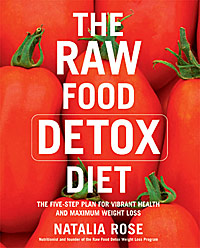
BTW, if you're interested in learning more about eating raw I recommend The Raw Food Detox Diet by Natalia Rose.
You can read about this book and order it here.
I don't agree with the "completely" raw philosophy (I also don't agree with the eating of processed "raw" food products or not combining fruits and vegetables), but I think Rose does an excellent job explaining the health benefits of eating raw as well as providing a sensible way to detox and go raw. Rose, like me, believes you have to make the changes gradually for them to stick.
Tuesday, July 12, 2011
Old Friends and New Juice Fasts
I've been perusing an old friend. Steve Meyerowitz's book Juice Fasting and Detoxification, was hugely inspiring to me on my weight loss journey, and I regularly refer back to it.
After I read this book, I bought my first juicer and started to juicing.
Since then, I've bought several other books on juice fasting, but Meyerwitz's book always seems to be the one I go back to.
I did, however, recently find a new website that has a lot of great information on detoxing and juice fasting. It's called "Greenlemonade" and you can find it here. It's a real good source of information if you just want to learn about juice fasting, or want to refresh your memory (something it seems I need to do more and more frequently as I age).
You can find good information on the basics of juice fasting here at the Greenlemonade website.. If you've never juice fasted before, or just want to learn a bit more about it, I recommend checking out some of the links including what to eat to prepare for a juice fast.
Now for my experience. I have to admit that I did not dive head first into juice fasting. I was more of a toe in the water kind of gal. I was so addicted to food and eating that I did not think it was possible for me to go even a day without eating.
I first experimented with just doing juice for breakfast or lunch, then breakfast and lunch and finally breakfast, lunch and dinner.
It turns out that I might have done myself a favor going it slow. If you leap into cleansing too fast, you can have some pretty ugly detoxing symptoms.
I also have to admit that I've never been able to do more than a three day juice fast. Not because I don't want to go longer, but with my life, it's a tough thing to do. You pretty much need a somewhat stress free period of time fast, and stress free periods don't come often around here.
In fact, when I have been able to accomplish my longer fasts it was because I started early, then headed up to the New Age Health spa to complete it. It's a wonderful spa in New York state with a fantastic juice fasting program. Generally, I'd prepare to fast the week before and actually start the fast on Thursday night. I head up to the spa Friday, fast until Sunday and then come home. While up there I relax (my husband takes the kids for the weekend), use the Sauna, have a colonic and come back feeling fantastic. I'd love to go up and stay longer (and fast longer), but that just isn't in the cards any time soon.
So, at home I'm generally only doing one or two day fasts.
I also like to just juice until dinner for up to a week at a time. I have juice for breakfast and lunch, then have a vegan (preferably as raw as possible) meal for dinner. This is also a fantastic way to ease yourself into more hard core juice fasting. I've also done fasts were I start out juicing until dinner then do a full scale juice fast for a day or two.
I'm writing about juice fasting now because it's Summer and hot as hell outside. I find that juice fasting (and reducing food consumption in general) is just easier when it's hot outside. I'm usually just to hot to feel hungry.
Time to start juice fasting.
Monday, July 11, 2011
Well Duh!!!
I always love it when studies are done to prove the obvious. Like this one which found that the rising rate of obesity among kids is due to poor eating and exercise habits and not genetics.
Friday, July 8, 2011
The Kid Quest--Trying New Stuff
I am always trying to get my kids to eat better which is a tough thing to do in a world in which they're surrounded by junk food ads, crap food in the supermarket, and nutritionally devoid kiddie menus (I have a girl-friend who thinks that kiddie menus are the sign of a civilization in decline, and I have to agree).
That said, I do try to get them to eat at least marginally better. First, I limit the junk food they can have in the house, and when I do allow it I stick to the "better class of crap" philosophy. I.e., if they have to eat pre-packaged, boxed junk at least let it be organic pre-packaged, boxed junk. I don't think that Annie's Organic Mac N Cheese is all that much of an improvement over Kraft, but at least it is somewhat of an improvement.
That said, I am always trying to find ways for my kids to eat more fruits and vegetables. Particularly my daughter who regards anything that actually came off a tree or plant as inherently disgusting.
A couple of years ago I discovered that both kids will eat ice pops I make from fresh fruit juice. I run watermelon, strawberries, blueberries, etc. through my juicer, pour the juice into one of those little plastic Popsicle makers, let freeze and Viola I have a snack that both kids will eat with no artificial colors, sugar or flavors. I also make jello out of fresh fruit juice by adding unflavored gelatin.
Today I'm going to try something new. I'm going to make a vegetable snack for the kids. Last week I bought a food dehydrator, and have been trawling the Internet for recipe ideas. Yesterday I found a recipe for salt-and-vinegar "raw" potato chips. You toss thinly sliced potato wedges with oil, apple cider vinegar and salt then dehydrate them for 15-24 hours in the dehydrator.
If I can get the kids to eat this healthier version of potato chips, I've scored again.
That said, I do try to get them to eat at least marginally better. First, I limit the junk food they can have in the house, and when I do allow it I stick to the "better class of crap" philosophy. I.e., if they have to eat pre-packaged, boxed junk at least let it be organic pre-packaged, boxed junk. I don't think that Annie's Organic Mac N Cheese is all that much of an improvement over Kraft, but at least it is somewhat of an improvement.
That said, I am always trying to find ways for my kids to eat more fruits and vegetables. Particularly my daughter who regards anything that actually came off a tree or plant as inherently disgusting.
A couple of years ago I discovered that both kids will eat ice pops I make from fresh fruit juice. I run watermelon, strawberries, blueberries, etc. through my juicer, pour the juice into one of those little plastic Popsicle makers, let freeze and Viola I have a snack that both kids will eat with no artificial colors, sugar or flavors. I also make jello out of fresh fruit juice by adding unflavored gelatin.
Today I'm going to try something new. I'm going to make a vegetable snack for the kids. Last week I bought a food dehydrator, and have been trawling the Internet for recipe ideas. Yesterday I found a recipe for salt-and-vinegar "raw" potato chips. You toss thinly sliced potato wedges with oil, apple cider vinegar and salt then dehydrate them for 15-24 hours in the dehydrator.
If I can get the kids to eat this healthier version of potato chips, I've scored again.
Thursday, July 7, 2011
Psyching Myself Raw
I try to eat as raw vegan as possible throughout the year, but have to admit that mid-winter in cold, damp New England it's pretty hard. But, as we move back into summer with a huge abundance of local fruits and vegetables, I'm psyching myself up to get more raw again. I'm probably at about 50-60% raw/vegan for the week right now, and I'd like to get the percentage up to at least 85-90% or even 100%.
I've been trawling the Internet for inspiration as well as new recipes. I read this blog over at HuffPo. The lady lost 45 pounds in 6 months by going raw/vegan. That's pretty inspiring.
I also found some interesting recipes over at this blog and this blog.
And, best of all, last week I finally bought a food dehydrator that will let me experiment with a whole new range of raw food recipes.
Thus far I've only used my new dehydrator. to dry surplus herbs from my garden. I've got so much dry oregano, chives and tarragon at this point that I'm thinking giving away bottles of home-grown, home-dried herbs as Christmas presents this year. Usually, if I can't give away my excess herbs, they wind up on the compost pile.
But, while dried herbs are nice, I'm looking forward to making raw kale chips, and other raw food recipes.
I don't see myself as ever going completely raw/vegan, but I do know that whenever I up my "raw percentage" significantly or even just go completely raw/vegan for a while, the weight falls off.
So, here's to psyching myself raw!!
I've been trawling the Internet for inspiration as well as new recipes. I read this blog over at HuffPo. The lady lost 45 pounds in 6 months by going raw/vegan. That's pretty inspiring.
I also found some interesting recipes over at this blog and this blog.
And, best of all, last week I finally bought a food dehydrator that will let me experiment with a whole new range of raw food recipes.
Thus far I've only used my new dehydrator. to dry surplus herbs from my garden. I've got so much dry oregano, chives and tarragon at this point that I'm thinking giving away bottles of home-grown, home-dried herbs as Christmas presents this year. Usually, if I can't give away my excess herbs, they wind up on the compost pile.
But, while dried herbs are nice, I'm looking forward to making raw kale chips, and other raw food recipes.
I don't see myself as ever going completely raw/vegan, but I do know that whenever I up my "raw percentage" significantly or even just go completely raw/vegan for a while, the weight falls off.
So, here's to psyching myself raw!!
Wednesday, July 6, 2011
Going Meatless--It Ain't Easy
Since I had several comments regarding the difficulty in getting the men-folk in our lives to go meatless for even just a couple of meals a week, I thought I'd relate again how I did it.
First of all, it's kind of like quitting smoking. If you try to make them go cold turkey, you get a back-lash.
Instead, I recommend a slow and steady stealth approach. The first step is to just reduce the amount of meat in a meal and up the vegetables and other ingredients.
A typical family dinner in my house used to consist of pasta with 1 pound of sausage in it. First I reduced the sausage to 3/4 of a pound, adding more pasta and veggies, then 1/2 pound and now I often make it with 1/4 pound or no sausage at all.
If you're making a roast, meat-loaf, burgers, chili etc. do the same thing. If you originally started with 2 pounds of ground meat for the family burger night, reduce to 1 3/4 pounds and add more veggies, etc., then 1 1/2 pounds etc.
You can easily substitute more beans for meat in chili. Meat-loaf is great because you can hide a lot of veggies in it (great if you have difficult kids). I saute up a bunch of carrots, celery and onions, puree it well (if my daughter even suspects that a vegetable is present she won't eat it), then add it to the meat along with whole-wheat bread-crumbs.
Another trick is to add substances with "meat-like" textures. Filling up the void left by the meat with Portabello mushrooms in a pasta dish gives them the feel of meat without the negative health consequences. Same thing with beans. Tofu is also a good substitute, although I must admit that I'm not much of a tofu fan and don't cook with it myself.
I also like to make my "almost meat-less meals." These meals have meat but just a touch of it. Although it sounds counter-intuitive, bacon or pancetta is great for this. Saute just a wee bit of bacon in a pan, add some steamed green beans or asparagus and pasta, and the whole dish has a bacon flavor.
That's not to say that I didn't have difficulties, and some pretty big battles. I can't tell you some of the knock down, drag out fights I had over my husband over eating fish (which he doesn't regard as "meat.") But, by standing my ground in getting the whole family to eat better, I eventually won the war.
My husband last night ate a meal of Cod, with zucchini, tomatoes, red onions and brown rice with no complaints.
First of all, it's kind of like quitting smoking. If you try to make them go cold turkey, you get a back-lash.
Instead, I recommend a slow and steady stealth approach. The first step is to just reduce the amount of meat in a meal and up the vegetables and other ingredients.
A typical family dinner in my house used to consist of pasta with 1 pound of sausage in it. First I reduced the sausage to 3/4 of a pound, adding more pasta and veggies, then 1/2 pound and now I often make it with 1/4 pound or no sausage at all.
If you're making a roast, meat-loaf, burgers, chili etc. do the same thing. If you originally started with 2 pounds of ground meat for the family burger night, reduce to 1 3/4 pounds and add more veggies, etc., then 1 1/2 pounds etc.
You can easily substitute more beans for meat in chili. Meat-loaf is great because you can hide a lot of veggies in it (great if you have difficult kids). I saute up a bunch of carrots, celery and onions, puree it well (if my daughter even suspects that a vegetable is present she won't eat it), then add it to the meat along with whole-wheat bread-crumbs.
Another trick is to add substances with "meat-like" textures. Filling up the void left by the meat with Portabello mushrooms in a pasta dish gives them the feel of meat without the negative health consequences. Same thing with beans. Tofu is also a good substitute, although I must admit that I'm not much of a tofu fan and don't cook with it myself.
I also like to make my "almost meat-less meals." These meals have meat but just a touch of it. Although it sounds counter-intuitive, bacon or pancetta is great for this. Saute just a wee bit of bacon in a pan, add some steamed green beans or asparagus and pasta, and the whole dish has a bacon flavor.
That's not to say that I didn't have difficulties, and some pretty big battles. I can't tell you some of the knock down, drag out fights I had over my husband over eating fish (which he doesn't regard as "meat.") But, by standing my ground in getting the whole family to eat better, I eventually won the war.
My husband last night ate a meal of Cod, with zucchini, tomatoes, red onions and brown rice with no complaints.
Tuesday, July 5, 2011
Meatless Mondays.
I've chronicled previously about the intra-family meat discord in my home.
To recap, I was raised in a large Italian family and my Italian immigrant grandmother did most of the cooking. That meant that we eat mostly peasant food and meat was pretty much a rarity in our house. We'd maybe get a leg of lamb on Easter, and Sunday dinner always meant "meat sauce," but at least two or three meals a week didn't have meat, eggs or fish in them. Even when meat was served, it was more of a side-dish.
My husband, on the other hand, grew up in a wealthy Jewish family that was pretty Americanized. Meat was on the menu every night, and was usually the central focus of the meal.
As an example, this weekend my family spent the weekend at my in-laws beach-front home. In one meal, my mother-in-law served a) grilled loin of pork, 2) grilled rack of lamb and 3) a bread stuffed with sausage and pepperoni. The only reason there were any vegetables on the table was that I went to a local produce stand and bought the ingredients for a tomato salad and some local corn which we grilled.
Despite 20 years of trying to wean my husband off the meat, he still gives me a hard time any time a meal doesn't have meat in it. We're talking about a dude who eats meat at every meal he eats out. I'm talking breakfast, lunch and dinner.
I bring this up because Mark Bittman has written a pretty thoughtful piece on Meatless Mondays. In it, he points out that not only can humans get protein from vegetable sources, but that those who are not so "meat dependent" tend to be healthier.
He says:
After years of cooking to try to make my husband happy (and putting on a lot of weight in the process) I now try to go meatless 2 to three days a week. My husband isn't all that happy (although his doctor is), but I'm trying to do good for us and for the planet.
To recap, I was raised in a large Italian family and my Italian immigrant grandmother did most of the cooking. That meant that we eat mostly peasant food and meat was pretty much a rarity in our house. We'd maybe get a leg of lamb on Easter, and Sunday dinner always meant "meat sauce," but at least two or three meals a week didn't have meat, eggs or fish in them. Even when meat was served, it was more of a side-dish.
My husband, on the other hand, grew up in a wealthy Jewish family that was pretty Americanized. Meat was on the menu every night, and was usually the central focus of the meal.
As an example, this weekend my family spent the weekend at my in-laws beach-front home. In one meal, my mother-in-law served a) grilled loin of pork, 2) grilled rack of lamb and 3) a bread stuffed with sausage and pepperoni. The only reason there were any vegetables on the table was that I went to a local produce stand and bought the ingredients for a tomato salad and some local corn which we grilled.
Despite 20 years of trying to wean my husband off the meat, he still gives me a hard time any time a meal doesn't have meat in it. We're talking about a dude who eats meat at every meal he eats out. I'm talking breakfast, lunch and dinner.
I bring this up because Mark Bittman has written a pretty thoughtful piece on Meatless Mondays. In it, he points out that not only can humans get protein from vegetable sources, but that those who are not so "meat dependent" tend to be healthier.
He says:
T. Colin Campbell, author of “The China Study” (a long-term study linking animal-based diets to chronic disease), insists that our protein quota can be met very nicely by a whole food, plant-based diet, and that it’s when we exceed the recommended amount (usually by eating a disproportionate amount of animal-based foods) that we can begin to see adverse effects, like increased risk of heart and kidney diseases, cancer and osteoporosis. Campbell suggests that in the past century we’ve had such a reverence for protein that we’ve mindlessly focused on the idea that we need as much as we can get. Consequently, we consume too much, at least twice as much as we need, and most of that from animal products.Bittman also goes into a little Diet for a Small Planet spin and points out how our meat addiction is bad for the planet as well. (BTW, I read DFASP in college and it still has relevance today.)
After years of cooking to try to make my husband happy (and putting on a lot of weight in the process) I now try to go meatless 2 to three days a week. My husband isn't all that happy (although his doctor is), but I'm trying to do good for us and for the planet.
Saturday, July 2, 2011
Beach Daze
Sorry for not posting, but I'm actually at the Jersey shore for the long weekend. I'm been too busy taking long beach walks, reading, napping, cooking, etc. to blog.
Be back soon.
Be back soon.
Thursday, June 30, 2011
A Bike Named Simple
There is an absolutely fantastic piece in Salon by a guy who lost 100 pounds after he moved from the mid-west to New York. For anyone trying to lose weight, I highly recommend reading the whole story.
How did he lose 100 pounds in a year?
This man's story is truly inspirational. He even made room in his diet plan for eating pizza frequently.
And, when he hit a plateau, he just started exercising more and even more weight came off.
So, in the end, the story is the same. More exercise and healthier eating lead to significant weight loss.
And, he realizes these are permanent changes:
How did he lose 100 pounds in a year?
Back in the Midwest, where I lived my entire adult life, the most common question was, "How did you do it?" Some people asked with a wink and nod -- you know those vain coastal people and their shortcuts. No, I didn't have surgery, didn't take supplements, didn't hire a trainer or even buy a miracle-cure book.
I walked more, and I ate less.Another thing that helped (and something I've strenuously advocated for) where calorie counts on menus:
Part of my diet plan was simple necessity. Back home, I drove a car everywhere I went. I cherry-picked parking spots to get as close to the door as possible, shaving my walk to the minimum. But my normal daily walk in New York City was about three miles, just getting to school, walking to work either in Greenwich Village or Midtown and meeting my friends and wife for dinner.
At the same time, I cut back my eating. The first week in New York I went to Chipotle, something familiar from back home, and I was confronted with a menu that prominently listed each item's calories, posted by law thanks to a 2008 regulation championed by Mayor Mike Bloomberg. The truth was shocking. The tortilla alone was 290 calories, plus beans and rice added another 250 calories. That was 540 calories before I even made a real choice. For my favorite burrito -- chicken with corn salsa and guacamole -- the grand total was about 960 calories. Here I was making "healthy choices" at Chipotle, and I'd blown nearly half a day's suggested calories.Just as I always argued, knowledge is key if you want to lose weight.
This man's story is truly inspirational. He even made room in his diet plan for eating pizza frequently.
And, when he hit a plateau, he just started exercising more and even more weight came off.
So, in the end, the story is the same. More exercise and healthier eating lead to significant weight loss.
And, he realizes these are permanent changes:
There is still a fat person inside of me, and keeping the weight off has not always been as easy. After hitting my goal, I gained 10 pounds back quickly and I realized I had to stay disciplined. I had to change my habits forever, not just for one year. Now I count my calories and weigh myself daily.
Wednesday, June 29, 2011
Your Diet Coke Problem is a Problem to Your Waist-line
If you think you're doing your waistline any favors by drinking a chemically-brewed, sugar free soda concoction your just plain out-right wrong. A couple of new studies found that people who drink diet sodas had bigger waists and were more likely to have diabetes then those who did not.
After completing a two decades long study epidemiologists from the School of Medicine at The University of Texas Health Science Center San Antonio reported data showing that diet soft drink consumption is associated with increased waist circumference in humans,
A second study that found aspartame raised fasting glucose (blood sugar) in diabetes-prone mice.
Quotable quote:
"Data from this and other prospective studies suggest that the promotion of diet sodas and artificial sweeteners as healthy alternatives may be ill-advised," said Helen P. Hazuda, Ph.D., professor and chief of the Division of Clinical Epidemiology in the School of Medicine. "They may be free of calories but not of consequences."
The statistics are mind boggling. The study showed that diet soft drink users, as a group, experienced 70 percent greater increases in waist circumference compared with non-users. Frequent users, who consumed two or more diet sodas a day, experienced waist circumference increases that were 500 percent greater than those of non-users.
So the science is clear. If you want a slim waist ditch the diet coke.
Tuesday, June 28, 2011
It's the Calories Dummy
A new study once again bursts the bubble concerning lower-calorie foods.
It turns out that we respond to calories in food more than taste. That's why when we eat low calorie versions of foods, we're not as satisfied. In a nutshell:
Your body isn't fooled by some low calorie pseudo-food. It wants the real thing, and so will respond by just eating more of whatever plasticized, aerated junk you're eating. In the end you wind up eating more calories then if you just went and how the real stuff to begin with.
The way to cut calories and lose weight (and maintain it once you've lost it) isn't to eat reduced calorie anything. The key to weight loss and maintenance is PORTION CONTROL.
Michael Pollan in his Food Rules exhorts to eat less, but eat better. The reality is, that once you get used to it, you really only need to eat a lot less then what you've grown accustomed to eat. We're so used to humongous, steroid-sized portions of food, that we've forgotten that we can actually survive all morning on what is now called a "mini" bagel.
The trick I found, was to gradually reduce portions so that my "new" normal is almost half the size of what I previously ate. Trying to reduce "cold turkey" didn't work because my body was used to the bigger portions and I was too hungry between meals. By gradually reducing porions, however, I adjusted with little discomfort.
So now when I want dessert (and because I have a sweet tooth, I frequently do), I can limit myself to one, really good cookie, or one scoop of really good ice cream. I take my time to eat my indulgence, and afterwards I'm completely satisfied.
It turns out that we respond to calories in food more than taste. That's why when we eat low calorie versions of foods, we're not as satisfied. In a nutshell:
We are so convinced that the tongue is the source of culinary joy — we eat too much ice cream because we want to make our mouth happy — but it’s not. Instead, we eat calorically dense foods because we are also trying to pleasure this secondary pathway, which responds not to the nuances of flavor but to the brute intake of energy. (On a more depressing note, this research also explains why the obesity epidemic is so hard to fix. Let’s imagine, for instance, that some genius invented a reduced calorie bacon product that tasted exactly like bacon, except it had 50 percent fewer calories. It would obviously be a great day for civilization. But this research suggests that such a pseudo-bacon product, even though it tasted identical to real bacon, would actually give us much less pleasure. Why? Because it made us less fat. Because energy is inherently delicious. Because we are programmed to enjoy calories.)I've blogged about this before. The reality is that if you want ice cream, you're better off eating a small bowl of real ice cream (and the absolute, best, creamiest, most natural stuff you can find), then eating a lot of some reduced calorie pseudo ice cream crap.
Your body isn't fooled by some low calorie pseudo-food. It wants the real thing, and so will respond by just eating more of whatever plasticized, aerated junk you're eating. In the end you wind up eating more calories then if you just went and how the real stuff to begin with.
The way to cut calories and lose weight (and maintain it once you've lost it) isn't to eat reduced calorie anything. The key to weight loss and maintenance is PORTION CONTROL.
Michael Pollan in his Food Rules exhorts to eat less, but eat better. The reality is, that once you get used to it, you really only need to eat a lot less then what you've grown accustomed to eat. We're so used to humongous, steroid-sized portions of food, that we've forgotten that we can actually survive all morning on what is now called a "mini" bagel.
The trick I found, was to gradually reduce portions so that my "new" normal is almost half the size of what I previously ate. Trying to reduce "cold turkey" didn't work because my body was used to the bigger portions and I was too hungry between meals. By gradually reducing porions, however, I adjusted with little discomfort.
So now when I want dessert (and because I have a sweet tooth, I frequently do), I can limit myself to one, really good cookie, or one scoop of really good ice cream. I take my time to eat my indulgence, and afterwards I'm completely satisfied.
Monday, June 27, 2011
Personal Set-backs
My shoulder has been acting up again. That means I've been unable to do many of my favorite asanas when I practice yoga, including Bakasana.
If you're unfamiliar with yoga, this is bakasana:
This asana is one of the first "I can't believe I'm actually doing this" asanas I achieved after I started practicing Ashtanga yoga.
If any of you have ever practiced yoga at a "serious" shala you know what I mean. You start by taking your first yoga class and you can't even touch your toes, then you look over in the room and there are yogis doing hand stands or putting their feet behind their heads. You look over at these contortionists and think "yeah, I'll never be doing that."
But, then you start practicing yoga regularly and before you know it you're standing on your head without leaning against the wall, and you can get your head down to your leg as you reach down and grab your feet. Lotus comes naturally after a couple years of regular practice.
You become amazed at what you accomplished, all the more so if, like me, you never started practicing yoga until well into your 40's.
Bakasana is actually not that hard to do once you've built up some upper body and core strength (from all those chattarungas) and you practice it. You simply place your knees onto your forearms, lift your head as a counter-balance, lean forward, and look out over the abyss.
The first time I was actually able to balance in bakasana I knew I could conquer just about anything yoga had to throw at me. I was so excited the day I first flew, that when my husband came home I had to demonstrate.
Before I knew it, the time I could remain in bakasana lengthened. Eventually I was able to lift myself up and kick out my feet to land squarely in chatturanga. Then I learned to move from bakasana to tripod headstand then back to bakasana and out to chatturanga.
I've always loved practicing bakasana. It's such an amazing freeing feeling to be up there, balancing my legs on my forearms, flying but for the tenous connection between the floor and my hands. When I'm in bakasana I feel that I can still do just about anything with my body now that I'm 50. I feel that age is no hinderance to anything I want to accomplish.
But for the past few weeks I can't practice bakasana because it's causing too much pain. This has happened periodically for the last few years. My shoulder hurts, I pull back on practice, it feels better, then all of a sudden the shoulder acts up again and I have to pull back. It's frustrating to come so far, only to be stopped because my body is not co-operating.
My shoulder has been an off and on problem for close to two years now. I don't know how I hurt it. There was no "ouch" moment when I suddenly realized that I hurt myself. It was a gradual pain that slowly got worse.
I've sought medical attention for it, and have been on anti-inflamatories, got physical therapy, etc. The pain subsides for a while, allowing me to go back to a full yoga practice, and get on with my life, but then the pain usually roars back to life again.
Last week I saw my orthopaedist again, and he's ordering an MRI.
The shoulder has, of course, been affecting other parts of my yoga practice beyond bakasana. Chatturangas hurt, so I've had to modify my sun salutations. I can't go all the way up in back-bends because I don't want to put pressure on my shoulder, etc.
It's affecting my life as well. Carrying in groceries has become painful because of my shoulder, When I'm working with my athletes for Special Olympics skiing, I often have to pull someone along, with great pain to myself. Sometimes just the weather makes it act up. I find myself taking Motrin or Advil for my shoulder every time it's damp and cold out.
My orthopaedist thinks I may need surgery. For a working mother, fitting surgery into my life is, of course, difficult.
But then I think about flying in bakasana and how much I want to be able to feel that freedom without the fear of feeling pain afterwards.
So, if the doctor says surgery is the answer, then surgery it will be.
Personal set-backs are always demoralizing and it's easy to lose focus and want to quit just because you can't progress the way you want. I've known plenty of yogis who stop practicing just because they're injured. They take sort of an all or nothing approach to the practice.
But I like to look at injuries as opporunities. Sometimes when we can't do something, it opens up our awareness to other things we may not have noticed previously. When I'm not injured, I'm so focused on pushing up to a full back-bend and remaining there, I often forget that the true purpose of a back-bend is to arch the back and stretch out all the muscles in the front of the body. By pulling back and not going all the way up, I can actually got deeper into the pose then I would otherwise.
If you're unfamiliar with yoga, this is bakasana:
This asana is one of the first "I can't believe I'm actually doing this" asanas I achieved after I started practicing Ashtanga yoga.
If any of you have ever practiced yoga at a "serious" shala you know what I mean. You start by taking your first yoga class and you can't even touch your toes, then you look over in the room and there are yogis doing hand stands or putting their feet behind their heads. You look over at these contortionists and think "yeah, I'll never be doing that."
But, then you start practicing yoga regularly and before you know it you're standing on your head without leaning against the wall, and you can get your head down to your leg as you reach down and grab your feet. Lotus comes naturally after a couple years of regular practice.
You become amazed at what you accomplished, all the more so if, like me, you never started practicing yoga until well into your 40's.
Bakasana is actually not that hard to do once you've built up some upper body and core strength (from all those chattarungas) and you practice it. You simply place your knees onto your forearms, lift your head as a counter-balance, lean forward, and look out over the abyss.
The first time I was actually able to balance in bakasana I knew I could conquer just about anything yoga had to throw at me. I was so excited the day I first flew, that when my husband came home I had to demonstrate.
Before I knew it, the time I could remain in bakasana lengthened. Eventually I was able to lift myself up and kick out my feet to land squarely in chatturanga. Then I learned to move from bakasana to tripod headstand then back to bakasana and out to chatturanga.
I've always loved practicing bakasana. It's such an amazing freeing feeling to be up there, balancing my legs on my forearms, flying but for the tenous connection between the floor and my hands. When I'm in bakasana I feel that I can still do just about anything with my body now that I'm 50. I feel that age is no hinderance to anything I want to accomplish.
But for the past few weeks I can't practice bakasana because it's causing too much pain. This has happened periodically for the last few years. My shoulder hurts, I pull back on practice, it feels better, then all of a sudden the shoulder acts up again and I have to pull back. It's frustrating to come so far, only to be stopped because my body is not co-operating.
My shoulder has been an off and on problem for close to two years now. I don't know how I hurt it. There was no "ouch" moment when I suddenly realized that I hurt myself. It was a gradual pain that slowly got worse.
I've sought medical attention for it, and have been on anti-inflamatories, got physical therapy, etc. The pain subsides for a while, allowing me to go back to a full yoga practice, and get on with my life, but then the pain usually roars back to life again.
Last week I saw my orthopaedist again, and he's ordering an MRI.
The shoulder has, of course, been affecting other parts of my yoga practice beyond bakasana. Chatturangas hurt, so I've had to modify my sun salutations. I can't go all the way up in back-bends because I don't want to put pressure on my shoulder, etc.
It's affecting my life as well. Carrying in groceries has become painful because of my shoulder, When I'm working with my athletes for Special Olympics skiing, I often have to pull someone along, with great pain to myself. Sometimes just the weather makes it act up. I find myself taking Motrin or Advil for my shoulder every time it's damp and cold out.
My orthopaedist thinks I may need surgery. For a working mother, fitting surgery into my life is, of course, difficult.
But then I think about flying in bakasana and how much I want to be able to feel that freedom without the fear of feeling pain afterwards.
So, if the doctor says surgery is the answer, then surgery it will be.
Personal set-backs are always demoralizing and it's easy to lose focus and want to quit just because you can't progress the way you want. I've known plenty of yogis who stop practicing just because they're injured. They take sort of an all or nothing approach to the practice.
But I like to look at injuries as opporunities. Sometimes when we can't do something, it opens up our awareness to other things we may not have noticed previously. When I'm not injured, I'm so focused on pushing up to a full back-bend and remaining there, I often forget that the true purpose of a back-bend is to arch the back and stretch out all the muscles in the front of the body. By pulling back and not going all the way up, I can actually got deeper into the pose then I would otherwise.
Friday, June 24, 2011
Fat Ronald
You know, if McDonalds is going to continue to use Ronald McDonald as a spokesperson, then I think they should update him to this:
After all, this image, by Ron English, better represents what McDonalds' food is all about. Maybe there should be public service announcements with with Fat Ronald eating a Whopper and saying "eat this, and you could look like me."
Frankly, I never saw the appeal of McDonalds food. I can honestly say that I haven't eaten in one since I was a teen-ager. I just never liked the food (one of the benefits to being a picky eater.) I'd go with my friends and just sit there sipping a diet soda (bad habit, I know, but I eventually broke that one).
As an adult, I've driven a hard line with my kids. I've never taken them to eat in a McDonalds (or Burger King), and although they've gone on occasion with friends or sitters, they know better than to ask me or their Dad to take them there.
The funny thing about not taking your kids to McDonalds is that there are a lot of people who seem to feel that its somewhat akin to child abuse.
I've had numerous discussions with people who try to impress on me that I am somehow denying my children some kind of fundamental aspect of kid-dom by not hauling them to McDonalds and teaching them to eat grease-laden, sodium-drenched food remnants.
Believe me they've had happy and content child-hoods despite the lack of Happy Meals (and don't get me started on those land-fill filling toys--how many billions of years will that Spider-man action figure be sitting in a landfill?).
Besides, what of the billions of children who grew up before McDonalds existed? Did they somehow or another have unfulfilled childhoods? McDonalds actually never came to my town until I was a teen-ager, so does that mean that all the kids growing up in Suburban New Jersey in the 1960's were deprived?
I've always preached that if you want to lose weight and keep it off, then you need to bring your whole family along in the journey.
No man is an island, and if you want to eat healthy, unprocessed nutritious food, your whole family has to eat that way. You can't eat healthy if you have a kitchenful of Cheetos, Doritos, Chips-a-Hoy and Lunchables--even if it's "just for the kids."
You know what?? Not only should you not be eating that crap, your kids shouldn't be either.
And, restaurant options can't include anything with a drive-thru window.
After all, this image, by Ron English, better represents what McDonalds' food is all about. Maybe there should be public service announcements with with Fat Ronald eating a Whopper and saying "eat this, and you could look like me."
Frankly, I never saw the appeal of McDonalds food. I can honestly say that I haven't eaten in one since I was a teen-ager. I just never liked the food (one of the benefits to being a picky eater.) I'd go with my friends and just sit there sipping a diet soda (bad habit, I know, but I eventually broke that one).
As an adult, I've driven a hard line with my kids. I've never taken them to eat in a McDonalds (or Burger King), and although they've gone on occasion with friends or sitters, they know better than to ask me or their Dad to take them there.
The funny thing about not taking your kids to McDonalds is that there are a lot of people who seem to feel that its somewhat akin to child abuse.
I've had numerous discussions with people who try to impress on me that I am somehow denying my children some kind of fundamental aspect of kid-dom by not hauling them to McDonalds and teaching them to eat grease-laden, sodium-drenched food remnants.
Believe me they've had happy and content child-hoods despite the lack of Happy Meals (and don't get me started on those land-fill filling toys--how many billions of years will that Spider-man action figure be sitting in a landfill?).
Besides, what of the billions of children who grew up before McDonalds existed? Did they somehow or another have unfulfilled childhoods? McDonalds actually never came to my town until I was a teen-ager, so does that mean that all the kids growing up in Suburban New Jersey in the 1960's were deprived?
I've always preached that if you want to lose weight and keep it off, then you need to bring your whole family along in the journey.
No man is an island, and if you want to eat healthy, unprocessed nutritious food, your whole family has to eat that way. You can't eat healthy if you have a kitchenful of Cheetos, Doritos, Chips-a-Hoy and Lunchables--even if it's "just for the kids."
You know what?? Not only should you not be eating that crap, your kids shouldn't be either.
And, restaurant options can't include anything with a drive-thru window.
Thursday, June 23, 2011
Science for Sale
Big tobacco was able to muddy the scientific waters for years by hiring scientists to produce "data" to obfuscate the truth regarding the dangers of cigarette smoking and second hand smoke.
The technique worked so well (by delaying the inevitable), that it was quickly picked up by Big oil to cloud the truth about climate change.
Now, with the increasing awareness of the negative health effects of obesity, we have a new industry willing to find sciencists to obfuscate. Big Sugar has now become the Sugar Daddy of any scientist willing to say that their products won't make you fat.
In a nutshell, a scientist who has taken money from Kraft, McDonald's, General Mills, Kellogg's, Mars and Nabisco, is now taking a position entirely contrary from every other "honest" (i.e., non-purchased) scientist that soda is a major contributor to the obesity epidemic in the US. Kind of like what Big Tobacco and Big Oil's scientists did, this guy is claiming that there is no "clear evidence."
Here's what they do:
The technique worked so well (by delaying the inevitable), that it was quickly picked up by Big oil to cloud the truth about climate change.
Now, with the increasing awareness of the negative health effects of obesity, we have a new industry willing to find sciencists to obfuscate. Big Sugar has now become the Sugar Daddy of any scientist willing to say that their products won't make you fat.
In a nutshell, a scientist who has taken money from Kraft, McDonald's, General Mills, Kellogg's, Mars and Nabisco, is now taking a position entirely contrary from every other "honest" (i.e., non-purchased) scientist that soda is a major contributor to the obesity epidemic in the US. Kind of like what Big Tobacco and Big Oil's scientists did, this guy is claiming that there is no "clear evidence."
Here's what they do:
In a recent commentary in the Journal of the American Medical Association, respected food researchers asserted that the industry has participated in "deceptive science and advocacy." They say "the food and beverage industry has created or funded front groups reminiscent of the tobacco institute that give the appearance of grassroots support."In a way, I can't blame Big companies for doing this. After all, they have businesses to run. But I do blame the "scientists" and organizations that take their money. It's plainly obvious that the scientific community needs higher ethical standards, and needs to enforce those standards stringently.
The groups, they say, include Americans Against Food Taxes and the Center for Consumer Freedom, organizations that are largely funded by the food and beverage industries.
"Big tobacco, big sugar," food researcher Popkin said, "identical in the way they treat scientists."
Popkin admits he has taken some industry money for research but, he says, turned down many of big food's most tantalizing offers.
"I've been offered $5,000 to go speak to this meeting or that meeting," he said. "You get $2,000 to $5,000 a day. They'll fly you on business class tickets to exotic places. They'll take you to Paris or Rio. They'll take you to places in Brazil."
The Children's Hospital of Philadelphia was criticized for taking $10 million for obesity research from the soda industry, and after the American Association of Family Physicians took money from Coca-Cola, some members ripped up their membership cards.
Wednesday, June 22, 2011
Selfish Giving Part Deux
Doing good while doing yourself bad. Sometimes you just got to see it to believe it:
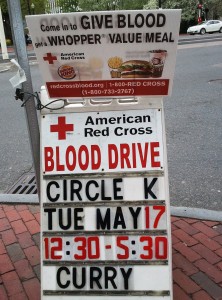
Give blood and you can get a Whopper to clog your arteries:
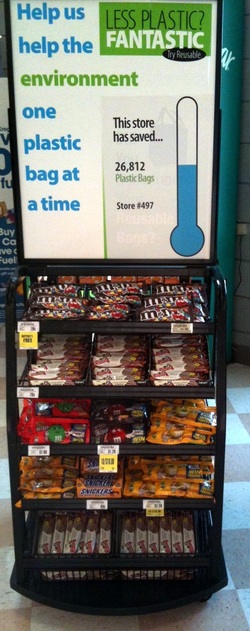
How about saving the planet, but polluting yourself?
What the cluck??? KFC offers buckets of chicken to help raise funds for Breast Cancer research?
And, how about Coco-Cola sponsoring continuing education courses for dieticians on, of all things, bone health?
If you want to read a good argument as to why not for profit organizations shouldn't take money from soda manufacturers, read it here.
Stephen Colbert, of course, has something to say on the matter.
Give blood and you can get a Whopper to clog your arteries:
How about saving the planet, but polluting yourself?
What the cluck??? KFC offers buckets of chicken to help raise funds for Breast Cancer research?
And, how about Coco-Cola sponsoring continuing education courses for dieticians on, of all things, bone health?
If you want to read a good argument as to why not for profit organizations shouldn't take money from soda manufacturers, read it here.
Stephen Colbert, of course, has something to say on the matter.
Tuesday, June 21, 2011
Salute the Sun
As I wrote over the Winter, I'm one of those people who is really affected by the lack of sunlight. As the Winter solstice approaches, all I want to do is go into "bear mode," and sleep all day. Getting out of bed in the dead of the night is a huge challenge for me, and by early afternoon, I usually find myself wanting to take a nap.
The exact opposite is true as to the Summer Solstice. As the days get longer, I find myself waking up earlier and staying up later. The sun is up around 5 am these days, and I'm up and out of bed with it.
The Summer Solstice for me is kind of like another New Years. It's a time to make new resolutions for eating healthier and finding ways to be more active during the day.
And, because I'm not in "bear mode," I generally find these resolutions easier to keep.
This year my Summer Solstice resolutions include recommitting to raw food. I was really, really good for quite a while in keeping at least 50-60% of my weekly diet raw, but that seems to have slipped some over the past 6 months. I'm resolving to not only eat at least 60% raw over the week, but even go higher than that to 75% now that summer is here and all kinds of fresh, locally grown, fruits and vegetables are available.
I'm also recommitting to reducing my refined sugars and grains. My sweet tooth, unfortunately, tends to get the best of me, and I've been eating far too much white bread.
Getting back into a daily yoga practice, again, is also on the list. I was really good at this for a while as well, but lately there have been days when I didn't even fit in a 10 minute practice. So it's back on the mat again for me.
BTW, in the Ashtanga yoga tradition, its traditional to do 108 sun salutations on the Summer Solstice.
The exact opposite is true as to the Summer Solstice. As the days get longer, I find myself waking up earlier and staying up later. The sun is up around 5 am these days, and I'm up and out of bed with it.
The Summer Solstice for me is kind of like another New Years. It's a time to make new resolutions for eating healthier and finding ways to be more active during the day.
And, because I'm not in "bear mode," I generally find these resolutions easier to keep.
This year my Summer Solstice resolutions include recommitting to raw food. I was really, really good for quite a while in keeping at least 50-60% of my weekly diet raw, but that seems to have slipped some over the past 6 months. I'm resolving to not only eat at least 60% raw over the week, but even go higher than that to 75% now that summer is here and all kinds of fresh, locally grown, fruits and vegetables are available.
I'm also recommitting to reducing my refined sugars and grains. My sweet tooth, unfortunately, tends to get the best of me, and I've been eating far too much white bread.
Getting back into a daily yoga practice, again, is also on the list. I was really good at this for a while as well, but lately there have been days when I didn't even fit in a 10 minute practice. So it's back on the mat again for me.
BTW, in the Ashtanga yoga tradition, its traditional to do 108 sun salutations on the Summer Solstice.
Subscribe to:
Posts (Atom)